TrueData™ SURVEYS
B2B CX Case Studies: TrueData™ in Practice
Our TrueData™ method moves the KPIs that matter most: Churn rate, revenue, and customer advocacy.



B2B Survey Experts + Third-Party Objectivity + Software Included
We bring certified CX analysts (CCXP) and proven methods. You’ll have an engaging survey with data you can trust.
B2B Case Study: How Yaskawa America Earned the Outstanding Customer Experience Award
In Brief: For the year of 2025, Yaskawa America’s Drives & Motion Division achieved an overall score of 90 with an NPS of 66. Interaction Metrics conducted the survey as they have been for the past 11 years.
Executive Summary
Yaskawa America’s Drives & Motion Division has been measuring customer experience with Interaction Metrics since 2014. Not a survey. A longitudinal study, run similarly every year for a client we work with closely.
Over the past decade, Yaskawa has earned recognition from us more than once. What they had never earned was the Outstanding Customer Experience Award, the highest tier we recognize. The 2025 study showed an overall score of 90 out of 100 and a Net Promoter Score of 66. The study spanned more than 2,800 distributors, OEMs, and end users across the United States and Canada.
Watch the video to see Martha Brooke present the award to Dennis Fitzgerald, Vice President of Customer Satisfaction at Yaskawa America. You’ll also learn in the video about some of the industries that Yaskawa covers.
The Challenge: Three Customer Types, and a Moving Target
Drives & Motion equipment goes into semiconductor fabs, packaging lines, HVAC-R systems, food and beverage plants, and many other industries. Yaskawa reaches them through Distributors, OEMs, and End Users. Three audiences with three different experiences of the same company.
Roll them into one average, and the number tells you nothing.
There is a second problem that most CX programs never solve. A single survey gives you a score without context. Is 87 good? Better than last year? Better on the dimensions that matter, or just better on the easy ones? Without consistent measurement over time, you can’t tell improvement from noise, and you can’t prove that anything you did actually worked.
The Approach: Consistent Measurement, Year After Year
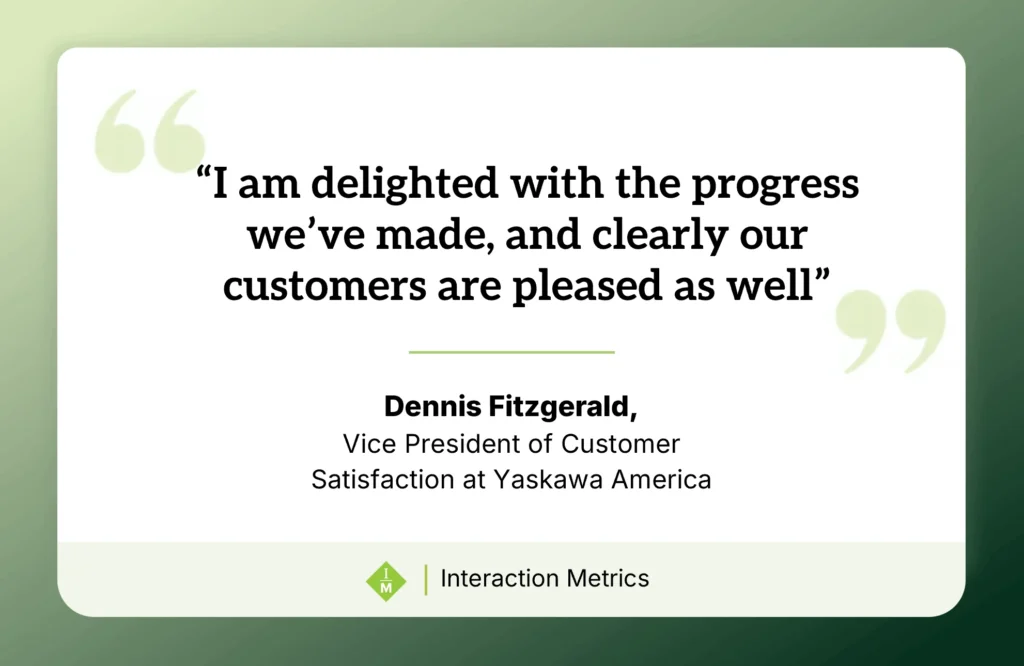
Eleven years of consistent measurement told Yaskawa what was working and what to fix next. “I am delighted with the progress we’ve made, and clearly our customers are pleased as well,” says Dennis Fitzgerald, Vice President of Customer Satisfaction at Yaskawa America.
Yaskawa runs two feedback programs with us, and they do different jobs.
The Daily Feedback Program captures sentiment right after operational touchpoints, while the interaction is still fresh. It surfaces problems at the level of a specific order, support call, or account.
The Annual Audit is a relationship survey. Every year, we field a study to a sample of the customer base and score 112 dimensions against the prior year and external benchmarks. Same method. Same rigor. That consistency is what makes the trend line real—and the fact that it comes from us, a third-party B2B survey firm.
Both the Daily Feedback Program and Annual Audit run on our TrueData™ model. Questions are written to strip out bias and correlation analysis sorts the results, separating the dimensions that move satisfaction from those that don’t.
The close work happens between cycles. We don’t hand over a report and leave. Each year’s findings become the next year’s priorities, and the daily program tracks whether the fixes are landing before the next audit confirms it.
The Findings
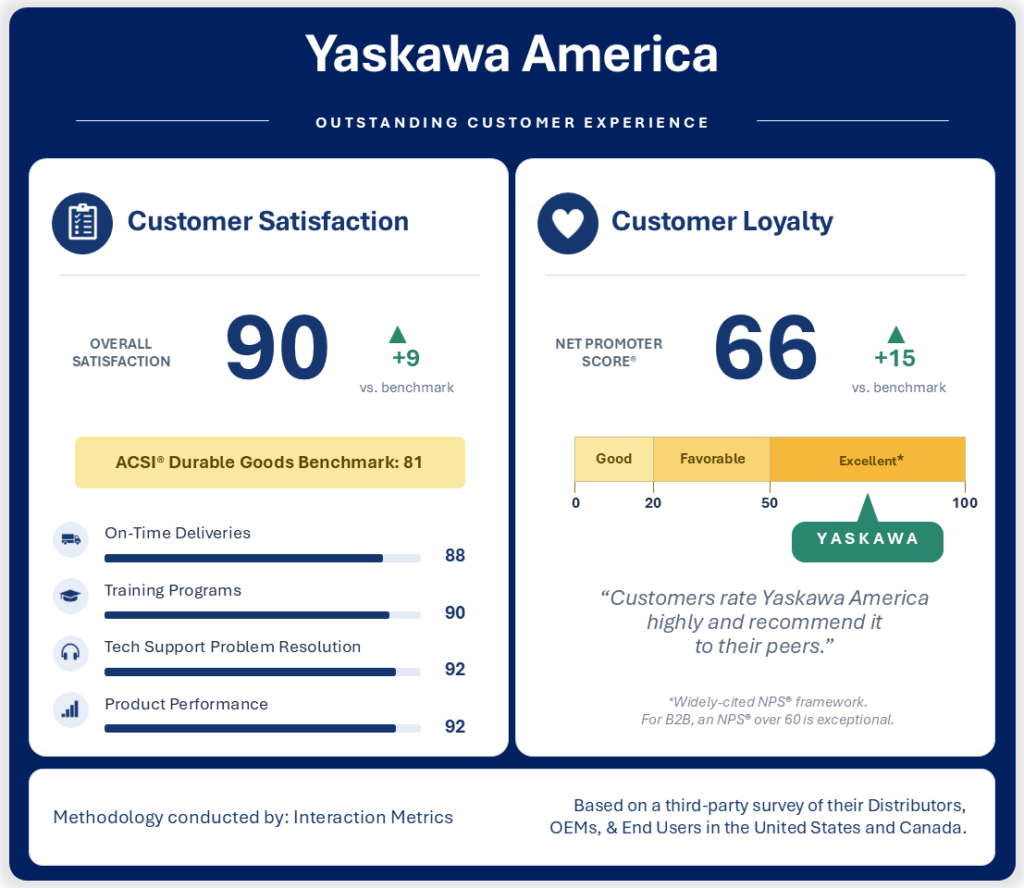
In 2025, overall satisfaction reached 90 out of 100, nine points above the ACSI® Durable Goods benchmark of 81. In addition to Net Promoter Score, ACSI® is a key number Yaskawa monitors. The Net Promoter Score reached 66, up more than four points from the prior year. In B2B, an NPS above 50 is a strong result.
The 2025 audit also mapped where experience varied by segment. Yaskawa is working on that roadmap through 2026. One of their credos is ‘never-ending improvement.’
Why Using a Third-Party Matters
Customers notice who is doing the asking.
“The fact that Yaskawa has invested in finding out how to help their customers speaks volumes about the company and the direction in which they are heading.” Large distributor, Northeast
Most companies underestimate that reaction. Sending your own survey signals that you don’t care about rigor and are not particularly invested in the customer experience. Customers read the difference immediately, and it changes what they tell you.
The entire team at Interaction Metrics knows Yaskawa’s business well and we work alongside their stakeholders. Independence is not distance. It is a method: we write the questions, we collect the data, and we report what comes back. The relationship is close. The instrument is precise.
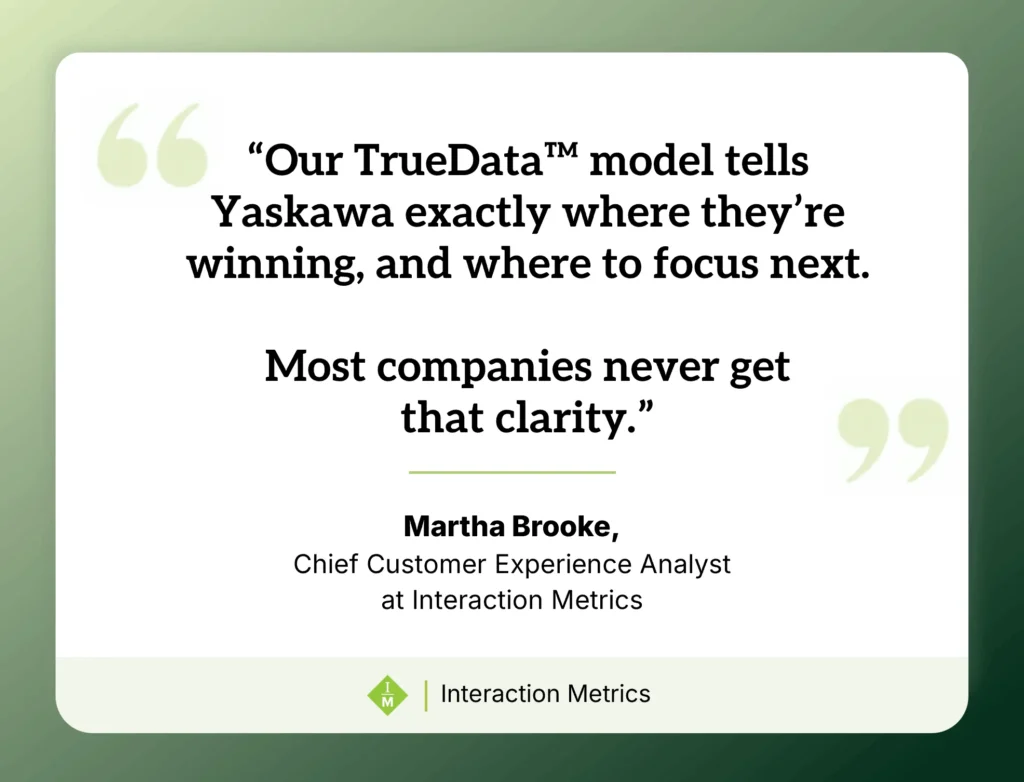
That’s the difference between a score and a plan. “Our TrueData™ model tells Yaskawa exactly where they’re winning, and where to focus next. Most companies never get that clarity,” says Martha Brooke, Chief Customer Experience Analyst at Interaction Metrics.
The Announcement
Yaskawa’s 2025 results were announced in April 2026. The full release carries the complete findings and commentary from both companies.
Takeaways for B2B Leaders
- Measure the same way (or at least similarly) every year. A consistent longitudinal study gives you a direction, and direction is what you can act on.
- Measure at the dimension level. A composite score tells you how you’re doing. It never tells you what to do. The decision lives one layer down.
- Find the correlations before you spend. Improving a dimension that customer’s don’t prioritize is bad ROI.
- Run both clocks. Continuous feedback catches problems as they arise. Biannual and annual surveys uncover patterns and strategic opportunities.
Interaction Metrics has conducted this study as an independent third party since 2014. Survey design, sampling, deployment, analysis, and reporting are handled in-house, with software included.
Talk to a Survey Expert
The world doesn’t need more customer surveys.
It needs better ones.
Relevant questions ➔ Reliable data ➔ Clear direction.
Curious or have a customer survey challenge? Share a few details. A CCXP-certified survey expert will follow up.


"*" indicates required fields
More TrueData™ Successes
Case: Southwest Engineering Manufacturer
KPI: Churn rate.
The Situation: Our client, a Midwest engineering manufacturer, was losing customers and finding out too late to save them. Churn was the visible metric. What the company didn’t have was an early warning system feeding it.
Our TrueData™ Approach: We built semi-annual TrueData™ surveys, designed to surface specific dissatisfaction patterns rather than overall sentiment scores. We added questions about competitors and the wider market. Plus, we supplemented the semi-annual program with daily quick surveys at key touchpoints.
The Result: Account teams now see warning signs months ahead of the renewal cycle. That window is long enough to intervene in individual relationships before customers have quietly decided to look elsewhere. Churn rate dropped by 12%.
Case: Northeast Automation Manufacturer
KPI: Revenue from existing accounts.
The Situation: Our client, a Northeast automation manufacturer, was running Net Promoter surveys and getting feedback, but not insight. The results kept confirming either nothing or what leadership already thought they knew.
Most importantly, none of the questions revealed which products customers wanted or how they wanted to buy. Revenue from existing accounts had plateaued, and none of the execs could say why.
Our TrueData™ Approach: We completely redesigned the survey and launched it as an annual TrueData™ program – with quarterly check-ins. Now we regularly surface unmet product needs and buyers’ preferences, which in turn unlock larger orders.
The Result: Accounts that the sales team had written off as fully tapped became a new source of revenue. Our surveys continually reveal which products customers want in larger quantities. The team has built outreach around those specific gaps. Revenue per existing account has grown by 6% year over year.
Case: Pacific Northwest Tool Supply Distributor
KPI: Customer advocacy.
The Situation: Our client, a Pacific Northwest tool supply distributor, was running templated post-interaction surveys that went out after each customer service interaction. The result was inflated five-star scores and no useful information about what to change. Customer advocacy looked strong on paper. The data was too smooth to be real.
Our TrueData™ Approach: Our TrueData™ surveys surfaced specific nuances in interactions and a running list of (mostly small) changes customers wanted. The result was an honest data feed, not inflated satisfaction averages.
The Result: This time, the scores meant something. And so targeted operational changes drove an 8% lift in customer referrals within enterprise corporations.
If churn, revenue, or advocacy matter this year, let’s talk.
Here’s Why Our Programs Work
We start with the KPI. What does your business need to change? What data would prove it changed? Many surveys skip that step.
We design for specifics, not averages. Five-star scores are easy to give and hard to use. What moves a business is naming a competitor a customer, or surfacing a product that customers wish you sold.
We run programs over quarters and years, not weeks. Real KPIs tend to move slowly. For example, you probably won’t fix churn in a quarter. Retention is a long-term business outcome, so the data has to keep coming in for the picture to hold.
Most of our clients work in tight markets, where competitive intelligence matters. Our contracts include a clause that keeps us from working with your three to five closest competitors during the engagement. It’s exclusivity you can count on.
The same multi-year structure is what gives you longitudinal data: the same customer base, measured with the same methodology, year after year. It’s how you can tell you are looking at an actual shift in perception, not just quarterly noise.
We’d love to talk about what longitudinal data can do for you.

A good customer survey isn’t one click. It’s dozens of steps.
We handle them all.
Let’s streamline your survey and give you data you can trust.
Built-In Features that Drive Growth

Software included.
No add-on costs. No upsells. No separate licenses. Just results.

Custom design. Bias-free.
Built from scratch to match your goals—no templates, no leading questions, no fluff.

Thematic insights.
Evidence-based, statistically valid data presented in priority order.

Human-coded text analysis + AI.
Every open-ended response coded for nuance and clarity.

Highest response rates!
100% deliverability. 100% engaging. Surveys customers want to take.

CEO-ready Findings Reports.
Action-focused presentations designed for executives and frontline teams.
Trusted by Companies Like Yours

We supply the oversight, trust, and alignment that AI can’t.
Use AI where it adds value, lose it where it doesn’t. Built for B2B teams that need survey experts, not another DIY tool.
Only Need Software
Level 1
If you already have your survey designed, power it up with the best software and the experts who know how to use it.
$1500-$3000
Complete Design & Deploy
Level 2
All your survey questions, logic flow, rating scales, email campaign, and every other step are managed for you.
$6000-$9900
Get The Analysis Too
Level 3
Crosstabs, correlations, text analysis, dashboards, and findings decks with next-step actions presented to your team.
Avg. $12000-$40000

Need Something More Tailored?
Not every challenge fits neatly into a package. We build custom research and survey strategies for teams with unique goals, complex audiences, or multi-phase initiatives.
Frequently Asked Questions
Bring it. We often start by analyzing what you have. Sometimes the audit alone changes how you think about the next survey.
No. We work inside whatever professional platform you already use. If you don’t have one, we’ll deploy on the software platform that fits. We have plenty of software licenses. The methodology matters more than the tool.
Less than you’d expect. We handle the design, the deployment, the outreach, the analysis. Your team’s job is to tell us what decisions the data needs to inform, and then act on what we find.
First findings come back in weeks. Real KPI movement takes longer. Churn rates and advocacy scores don’t shift on a quarterly cycle, which is why our programs run for years. If you just need a one-time read, we can do that. It’s a different project.
Yes. Book a TrueData™ Demo and we’ll walk through anonymized examples from real engagements. The demo is also where we figure out if we’re the right fit. It goes both ways.
More Resources:

Rules for Writing B2B Customer Satisfaction Survey Questions
Last Updated: February 10, 2026 Effective B2B customer satisfaction surveys are designed to produce decisions, not just data. To move beyond generic ratings, B2B firms must use role-based routing, suppression strategies, and expectation-gap mapping. This guide outlines the essential rules for transforming B2B surveys into strategic assets that protect revenue and improve customer retention. The […]

The Cost of Customer Satisfaction: B2B Survey Program Costs
Last Updated: February 24, 2025 Key Takeaways: What are typical customer survey program costs? Clients ask this all the time, and the answer varies widely. A simple, off-the-shelf survey might cost very little, while a B2B survey program with multiple customer types, account data, segmentation, and deeper analysis requires a bigger investment. If you’re considering […]

5 Ways B2B CX Stands Apart
In 90 seconds, Kaitlyn Bartley explains 5 ways B2B CX is different. This is an excellent explainer video, click on it above. Want to put these B2B CX truths to work? Read the full report for four practices that will help you improve your customer surveys. Interaction Metrics helps B2B companies uncover the drivers of […]

22 Best Practices for Surveys: Tips for Writing, Design, and Analysis
Key Takeaways: You’ve probably been on the receiving end of a bad survey. Maybe it asked you to rate a delivery you never received. Or it forced you to choose between three irrelevant response options, none of which applied to you. Or perhaps you actually took the time to explain a problem in your own […]