TrueData™ SURVEYS
Employee Surveys: How to Choose the Right One
Different employee surveys measure different things. Here’s how to pick the right one.

B2B Survey Experts + Third-Party Objectivity + Software Included
We bring certified CX analysts (CCXP) and proven methods. You’ll have an engaging survey with data you can trust.
Each Survey Type Is Built for a Different Decision
Employee surveys are structured tools used to measure loyalty, satisfaction, engagement, culture, and experience. But different survey types are built for different decisions — and fielding the wrong one is a fast way to collect data that employees won’t trust and leaders can’t use.
Some surveys measure the overall strength of the employee relationship. Others evaluate a specific program, process, or moment in the employee journey.
That’s why employee survey strategy matters as much — if not more — than your survey software. All survey platforms (SurveyMonkey, Qualtrics, Alchemer, etc.) can send questions and collect responses. But none of them determine what to ask, when to ask it, how to reduce bias, or how to interpret the data in a way that leads to real decisions.
Talk to a Survey Expert
The world doesn’t need more customer surveys.
It needs better ones.
Relevant questions ➔ Reliable data ➔ Clear direction.
Curious or have a customer survey challenge? Share a few details. A CCXP-certified survey expert will follow up.


"*" indicates required fields
How the Right Survey Leads to Better Decisions
The value of an employee survey is in getting honest answers to the real questions in front of you.
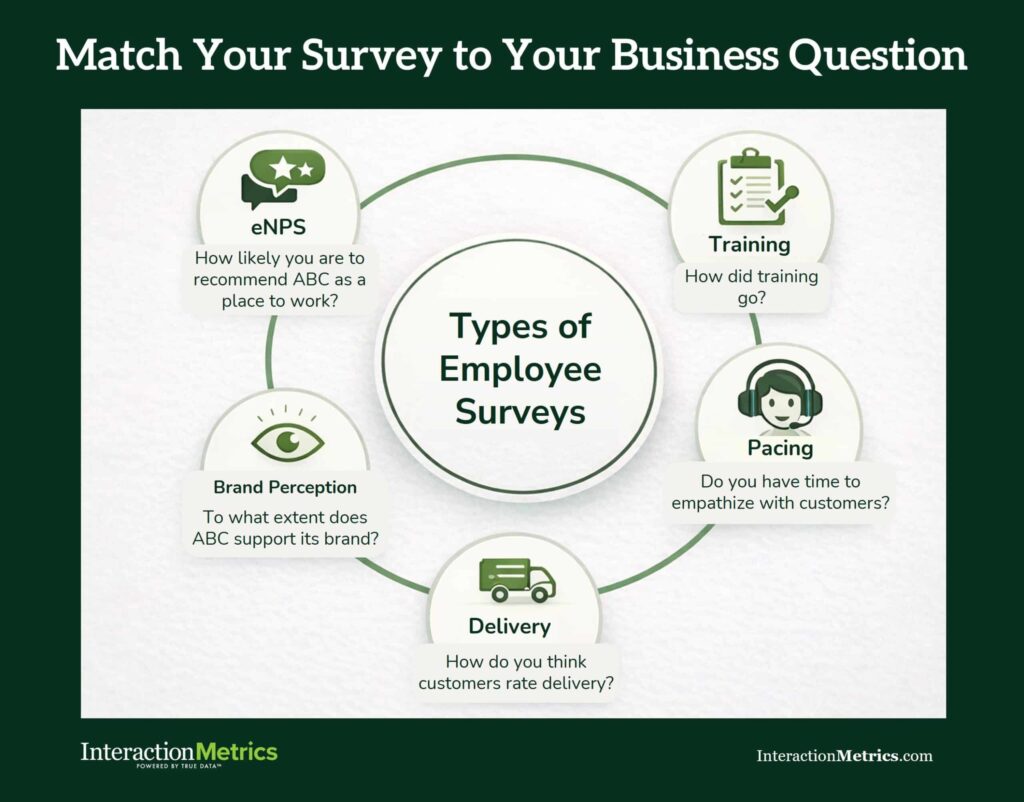
- If you need to understand whether employees plan to stay and would recommend you as an employer, use a survey that measures loyalty. (eNPS Surveys)
- If you want to know how a recent initiative, policy change, or training program landed, use a survey that measures that specific moment. (Training Surveys)
- If your goal is to understand whether employees feel energized and connected to their work, your survey must measure engagement — not just satisfaction.
Use the right type of survey, and your results will be actionable. Use the wrong type, and you’ll waste both your time and your employees’ time. Bottom line: don’t be content to collect feedback. Employee surveys only work when employees believe the process is serious — and when leadership can show that honest answers lead somewhere.
Capturing How Employees Feel
Employee Feedback Surveys serve as your listening tool for the unfiltered truth, because we invite staff to speak freely about their opinions, concerns, and ideas.
Sure, we include rating questions. But capturing the voice of the employee is also about qualitative feedback, where we derive insights that explain ‘why’ employees feel the way they do.
Ready to uncover blind spots? Contact us. By the way, we use best-in-class software tools—including Qualtrics, SPSS, Power BI, and more. With us, the entire process of Employee Feedback is managed end-to-end, so more than ‘data’, you get ‘answers you can use.’
TrueData™ Surveys are for B2B Companies
with High-Value Customer Relationships


A good employee survey isn’t one click. It’s dozens of steps.
We handle them all.
Let’s streamline your survey and give you data you can trust.
Trusted by Companies Like Yours



We supply the oversight, trust, and alignment that AI can’t.
Use AI where it adds value, lose it where it doesn’t. Built for B2B teams that need survey experts, not another DIY tool.
Only Need Software
Level 1
If you already have your survey designed, power it up with the best software and the experts who know how to use it.
$1500-$3000
Complete Design & Deploy
Level 2
All your survey questions, logic flow, rating scales, email campaign, and every other step are managed for you.
$6000-$9900
Get The Analysis Too
Level 3
Crosstabs, correlations, text analysis, dashboards, and findings decks with next-step actions presented to your team.
Avg. $12000-$40000

Need Something More Tailored?
Not every challenge fits neatly into a package. We build custom research and survey strategies for teams with unique goals, complex audiences, or multi-phase initiatives.
How to Collect Employee Feedback: Surveys and Beyond
Surveys are among the most efficient methods for collecting employee feedback because they produce structured, comparable data. They make it possible to spot patterns across teams, track change over time, and benchmark employee engagement metrics, employee satisfaction metrics, and employee experience metrics across departments, locations, or business units.
But surveys aren’t the only way to gather employee feedback. Companies also use focus groups, one-on-one interviews, listening sessions, and exit feedback to understand the employee experience from different angles.
The strongest employee feedback programs combine methods. A company might use an eNPS survey to measure loyalty, an engagement survey to assess motivation and commitment, pulse surveys to monitor sentiment between larger cycles, and interviews to uncover the reasons behind the scores. Together, those methods create a far more complete picture than any single approach can.
The Main Types of Employee Surveys We Offer
At Interaction Metrics, we offer employee surveys as part of broader listening and feedback programs. Each type serves a different purpose.
Relationship-Level Surveys
These surveys measure the overall strength of the employee relationship with the organization.
Employee Net Promoter Score (eNPS) Surveys
eNPS surveys measure loyalty and advocacy by asking one focused question: how likely are you to recommend this organization as a place to work? eNPS provides a useful directional signal, but it’s strongest when paired with open-ended follow-up that explains the score. As a standalone metric it tells you where you stand; it doesn’t tell you why.
Employee Engagement Surveys
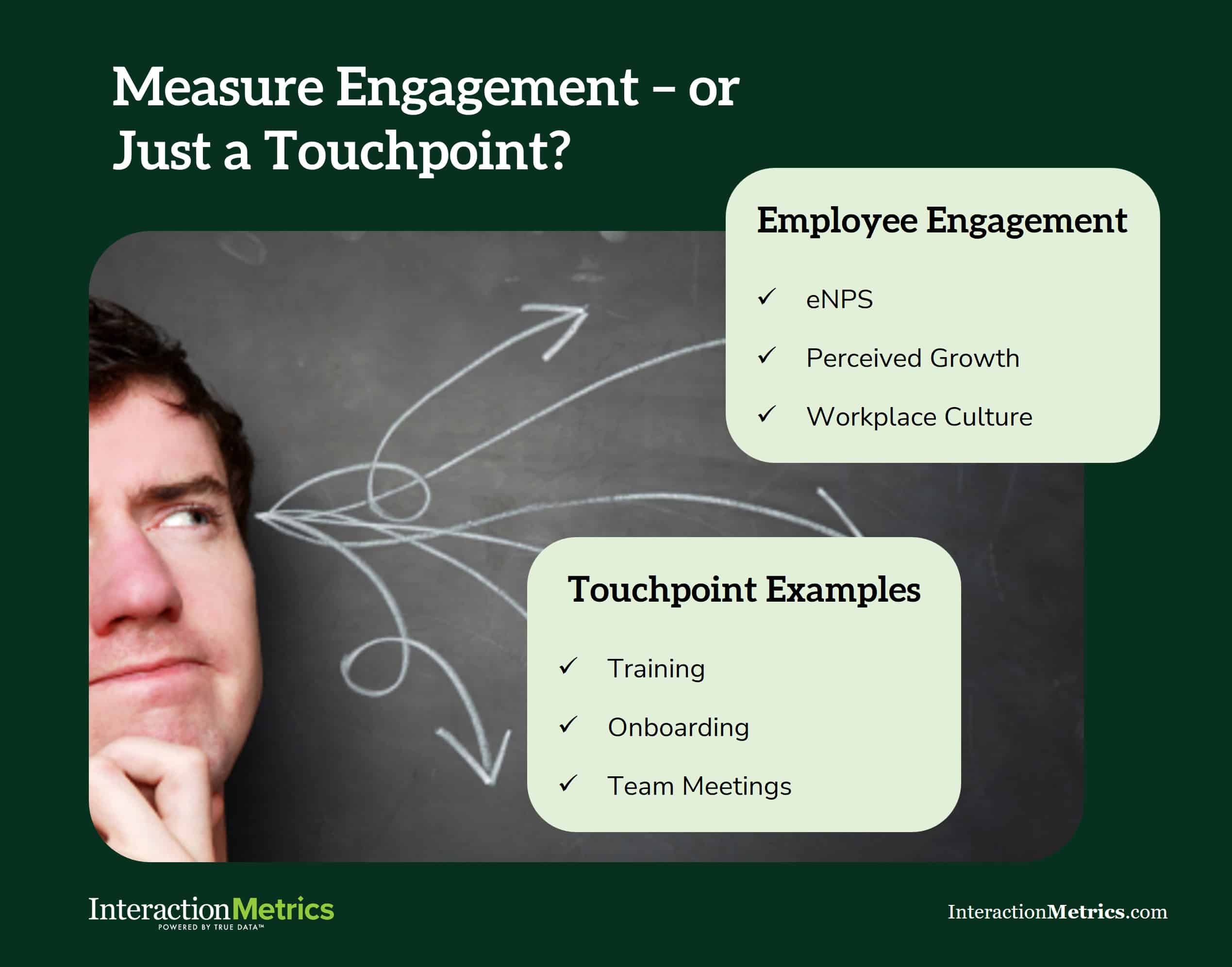
Employee engagement measures emotional commitment, motivation, and willingness to invest effort. It’s the right tool when leadership wants to understand retention risk, performance culture, and whether employees feel genuinely connected to their work and the organization’s direction.
Employee Satisfaction Surveys
Employee satisfaction measures whether employees feel content with their job, environment, compensation, and working conditions. It helps identify broad areas of satisfaction and dissatisfaction across teams, functions, or locations — and are especially useful when the decision involves management support, benefits, workload, or the day-to-day work environment.
Ongoing Listening Surveys
These surveys keep the listening system active between major measurement cycles.
Pulse Surveys
Pulse surveys are shorter, more frequent surveys used to monitor morale, detect change, and surface emerging issues before they compound. They work best when questions are focused and consistent enough to track over time — and when leadership responds visibly to what they reveal.
Topic-Specific Surveys
These surveys focus on a particular part of the employee experience.
Workplace Culture Surveys
Workplace culture surveys measure shared values, behaviors, communication patterns, and team norms. They’re used when leadership wants to understand whether the lived culture matches the intended one — and where the gaps are. Often most valuable during periods of growth, change, or deliberate culture-building.
Post-Training Surveys
Post-training surveys measure whether learning programs were effective, clear, and applicable on the job. They can be fielded immediately after training or weeks later to assess retention and practical application. For organizations that invest significantly in employee development, training surveys are essential for understanding whether that investment is actually working.
Cheat Sheet: How to Choose the Right Employee Survey
Start with the decision, then match the survey to it.
- Measure employee loyalty and advocacy → eNPS
- Understand emotional commitment and retention risk → Employee Engagement Survey
- Assess whether employees feel content with their conditions → Employee Satisfaction Survey
- Diagnose culture and values alignment → Workplace Culture Survey
- Monitor morale between major listening cycles → Pulse Survey
- Evaluate a learning initiative → Training Survey
The right type of employee survey gives you more than a score. It gives you findings you can act on and a clearer picture of where your organization actually stands.
Ready to discuss employee engagement and retention?
Frequently Asked Questions
The main types of employee surveys include eNPS surveys, employee engagement surveys, employee satisfaction surveys, employee experience surveys, workplace culture surveys, pulse surveys, training surveys, and employee feedback surveys. Each is designed for a specific listening goal and answers a different question about the employee experience.
Employee engagement measures emotional commitment, motivation, and willingness to invest effort. Employee satisfaction measures whether employees feel broadly content with their job and conditions. A satisfied employee isn’t necessarily an engaged one — and engagement is the stronger predictor of retention and performance.
Employee experience is the full arc of what employees encounter at your company — from onboarding through offboarding. Employee engagement is a key signal within that experience: how energized and committed employees feel in their day-to-day work. Experience is the broader system; engagement is one outcome of it.
Trustworthy employee surveys protect anonymity appropriately, ask questions employees can genuinely evaluate, and — most critically — connect to visible action afterward. If employees don’t believe feedback leads anywhere, future surveys produce guarded responses and unreliable data. Trust has to be built into the design, not assumed.
Strong employee surveys use clear, unbiased language, ask about issues employees can realistically assess, use the right cadence for the goal, and report results in ways that protect confidentiality while enabling action. Equally important: communicating what was learned and what will change. Without that step, the listening program loses credibility quickly.
No. Employee engagement metrics measure investment, motivation, and discretionary effort. Employee satisfaction metrics measure contentment with compensation, environment, and conditions. Both are valuable, but they answer different questions and should not be used interchangeably.
More Resources:

Your Employee Engagement Questionnaire: What to Ask
Are you an HR Director, Head of People, HRBP, Chief People Officer, or a business leader responsible for retention and performance? If so, this article is for you, because, presumably, your goal isn’t merely to collect employee feedback and measure employee engagement, it’s to get honest insight you can use. First, let’s start with a […]

The Cost of Customer Satisfaction: B2B Survey Program Costs
Last Updated: February 24, 2025 Key Takeaways: What are typical customer survey program costs? Clients ask this all the time, and the answer varies widely. A simple, off-the-shelf survey might cost very little, while a B2B survey program with multiple customer types, account data, segmentation, and deeper analysis requires a bigger investment. If you’re considering […]

How To Calculate Sample Size & Supercharge Your CX Program
Last Updated: January 10, 2025 Key Takeaways: Clients often ask, “How do we get every customer to take our survey?” But here’s the counterintuitive truth: you don’t need everyone’s feedback to get the real picture, which is why today I am addressing how to calculate sample size. Sampling is the art and science of choosing […]

22 Best Practices for Surveys: Tips for Writing, Design, and Analysis
Key Takeaways: You’ve probably been on the receiving end of a bad survey. Maybe it asked you to rate a delivery you never received. Or it forced you to choose between three irrelevant response options, none of which applied to you. Or perhaps you actually took the time to explain a problem in your own […]
Talk to a Survey Expert
The world doesn’t need more customer surveys.
It needs better ones.
Relevant questions ➔ Reliable data ➔ Clear direction.
Curious or have a customer survey challenge? Share a few details. A CCXP-certified survey expert will follow up.
"*" indicates required fields