TrueData™ SURVEYS
Customer Surveys: How to Choose the Right One
Different customer surveys measure different things. Here’s how to pick the right one.

B2B Survey Experts + Third-Party Objectivity + Software Included
We bring certified CX analysts (CCXP) and proven methods. You’ll have an engaging survey with data you can trust.
Each Survey Type Is Built for a Different Decision
Customer surveys are structured tools used to measure loyalty, satisfaction, effort, perception, and experience.
But different survey types are built for different decisions — and choosing the wrong one means you’ll end up with data that looks informative but tells you nothing.
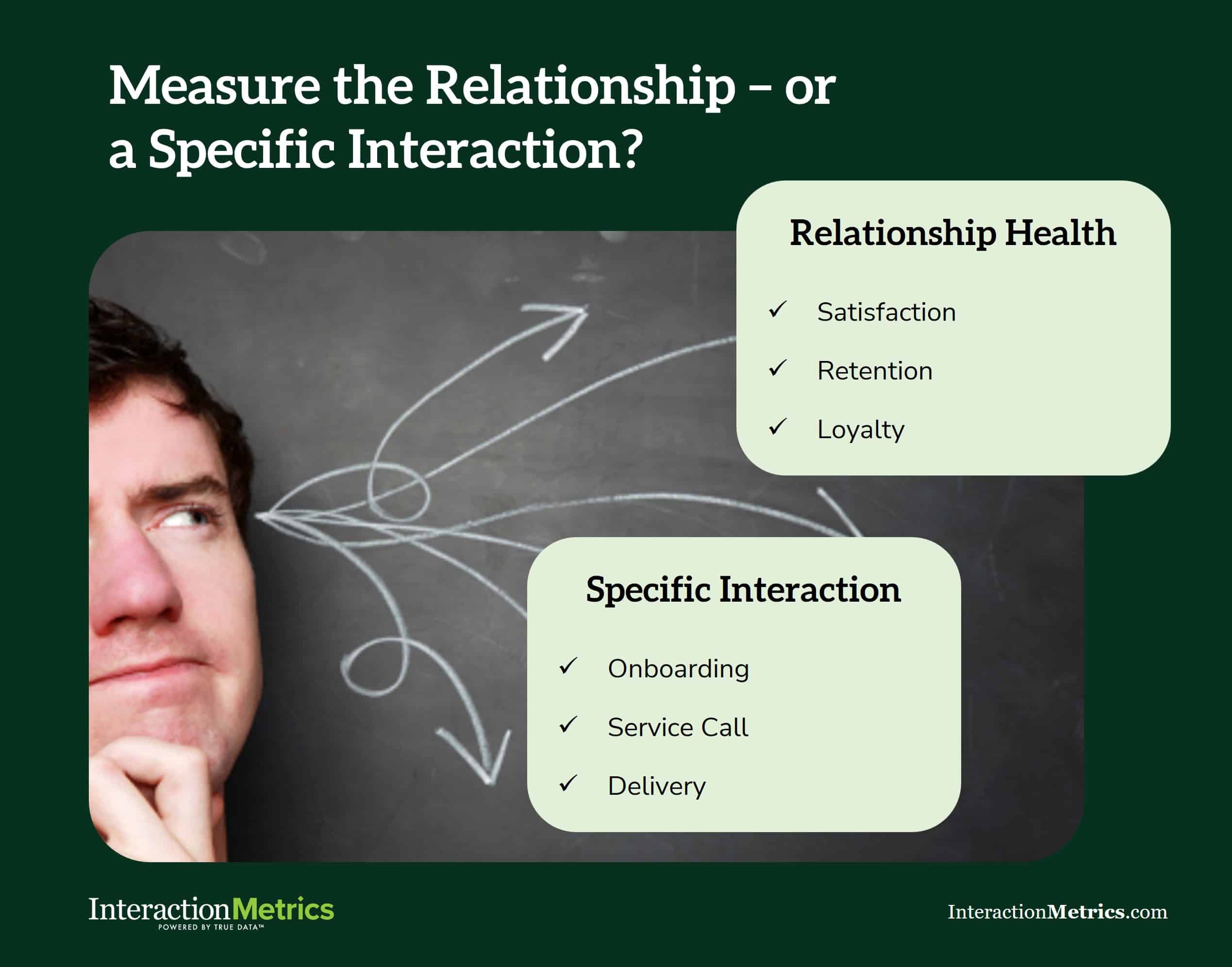
Some surveys measure the overall strength of the customer relationship. Others evaluate a specific interaction or process.
That’s why customer survey strategy matters as much — if not more — than your customer survey software. All survey platforms (Survey Monkey, Qualtrics, Alchemer, etc.) can send questions and collect responses. But none of them determine what to ask, when to ask it, how to reduce bias, or how to comprehensively interpret the data.
Talk to a Survey Expert
The world doesn’t need more customer surveys.
It needs better ones.
Relevant questions ➔ Reliable data ➔ Clear direction.
Curious or have a customer survey challenge? Share a few details. A CCXP-certified survey expert will follow up.


"*" indicates required fields
How the Right Survey Leads to Better Decisions
The value of a customer survey is in getting honest answers to the real questions in front of you.
- If you need to know whether customers will stay, renew, and recommend you, use a survey that measures loyalty. (NPS Surveys)
- If you want to know how a recent onboarding experience, service call, or delivery went, use a survey that measures that specific interaction. (Onboarding Surveys)
- If your goal is to identify friction in your processes, your survey must measure effort and ease.
Use the right type of survey, and your results will be actionable. Use the wrong type, and you’ll waste both your time — and your customers’ time too.
Bottom line: don’t be content to collect feedback. Instead, set your sights on building a listening system — because a well-designed survey doesn’t just generate data — it helps you make decisions.
A Year of Honest Answers
The list below is a handful of real findings from the past year, drawn from hundreds of insights we’ve collected.
- Employees who needed reassignment, or removal from certain roles
- Customer training programs that lacked the depth OEMs needed
- Contracts so laden with jargon that customers decided not to sign
- Distributors who went silent at critical moments, losing sales for our client
- Invoices that didn’t match what was ordered or delivered
- Pricing that felt out of touch with the competition
- Tech support issues that escalated when they should have been handled on the spot
- Service processes that required too many calls and handoffs
TrueData™ Surveys are for B2B Companies
with High-Value Customer Relationships


A good customer survey isn’t one click. It’s dozens of steps.
We handle them all.
Let’s streamline your survey and give you data you can trust.
Trusted by Companies Like Yours


A Smarter Look at CX
Billions of surveys go out every day. NPS scores barely budge. Martha explains why in 90 seconds — and it comes down to science.
The Interaction Metrics Difference
- Scientific Survey Design: We build surveys that measure what matters — no leading questions, no bias baked in.
- Third-Party Objectivity: As an outside partner, we surface truths your internal team can’t see.
- Statistically Valid Facts: We use proven methodologies, so your data captures reality, not distortions.
Your Customers Have Answers. Are You Ready to Listen?
Customer Feedback Surveys are a broad category of surveys designed to gather input on any aspect of the customer’s experience, from product quality to service interactions.
Often, we gather facts about the entire customer journey—from sales, through support, billing, and more. We can even include competitor comparisons to show how your customers perceive you in the context of your marketplace, not just in isolation.
Every question we ask is tested using elite methodologies like Six Sigma and certified CCXP frameworks to eliminate bias and give you clear, next-step actions. As a full-service partner, we manage survey design, delivery, analysis, and reporting—giving you expert-led feedback without the complexity.

We supply the oversight, trust, and alignment that AI can’t.
Use AI where it adds value, lose it where it doesn’t. Built for B2B teams that need survey experts, not another DIY tool.
Only Need Software
Level 1
If you already have your survey designed, power it up with the best software and the experts who know how to use it.
$1500-$3000
Complete Design & Deploy
Level 2
All your survey questions, logic flow, rating scales, email campaign, and every other step are managed for you.
$6000-$9900
Get The Analysis Too
Level 3
Crosstabs, correlations, text analysis, dashboards, and findings decks with next-step actions presented to your team.
Avg. $12000-$40000

Need Something More Tailored?
Not every challenge fits neatly into a package. We build custom research and survey strategies for teams with unique goals, complex audiences, or multi-phase initiatives.
The Main Types of Customer Surveys We Offer
At Interaction Metrics, we offer a wide variety of surveys along with end-to-end customer experience strategies. A few of the most popular surveys we offer are these.
Net Promoter Score (NPS) Surveys
NPS surveys measure customer loyalty and likelihood to recommend. They’re used to assess overall relationship health, identify retention risk, and track whether customer sentiment is improving or declining over time. NPS is most useful when you need a high-level read on relationship strength.
Customer Satisfaction (CSAT) Surveys
CSAT surveys measure satisfaction with a specific interaction, touchpoint, product, or service moment. They can also be applied more broadly to track whether you’re meeting customer expectations across accounts, locations, or business units. CSAT is one of the most direct ways to find out whether a specific experience landed the way you intended.
Customer Effort Score (CES) Surveys
CES surveys measure how easy or difficult it is for customers to complete a task — placing an order, reaching support, resolving an issue, or finding information. CES is especially valuable when ease of doing business directly affects retention. High friction can silently weaken the relationship even when other scores still look fine.
Customer Service Surveys
Customer service surveys measure the quality of frontline service interactions. They evaluate responsiveness, communication, professionalism, and problem resolution. For companies where service is part of the brand promise, this survey type is often essential for understanding whether service delivery is building trust or damaging it.
Brand Perception Surveys
Brand perception surveys measure how customers and prospects view your company in the market. They assess awareness, trust, differentiation, and competitive reputation — making them valuable for positioning, messaging, and market strategy.
Voice of the Customer (VoC) Surveys
VoC surveys capture what customers want, expect, and need. They’re used to turn customer input into strategic direction by connecting feedback to business priorities, product decisions, service improvements, and experience design.
Due Diligence Questionnaires (DDQs)
DDQs measure customer relationship health and revenue risk before an acquisition, investment, or major transaction. They combine structured questions with one-on-one interviews to surface concentration risk, contract vulnerabilities, churn signals, and the real durability of key accounts. Buyers, lenders, and PE firms use DDQs to confirm that the customer base actually supports the deal thesis.
Customer Interviews
Customer interviews capture the depth and nuance that surveys can’t reach on their own. They’re used to understand the “why” behind survey scores, explore complex B2B relationships, and surface unspoken concerns that customers won’t put in writing. Interviews are particularly valuable when account values are high and a single relationship can shift the trajectory of the business.
Cheat Sheet: How to Choose the Right Customer Survey
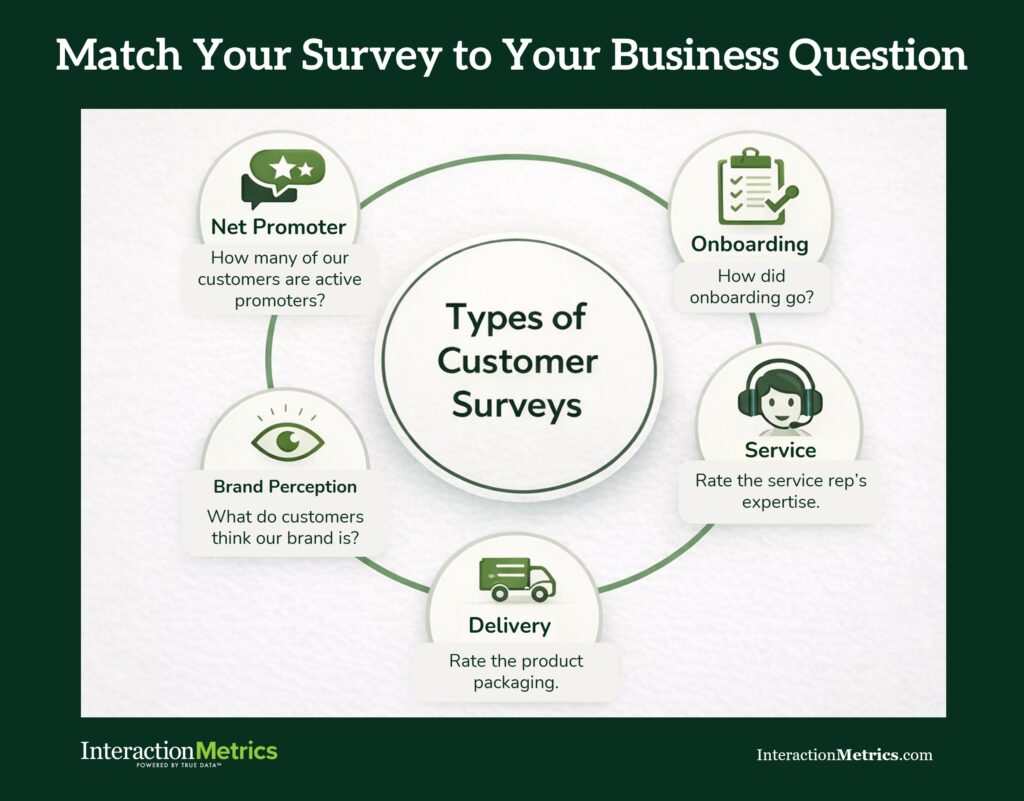
Match the survey to the decision you need to make:
- Measure customer loyalty → NPS
- Evaluate a specific interaction, touchpoint, or service area → CSAT
- Identify process friction → CES
- Assess market and competitive perception → Brand Perception Survey
The right type of customer survey gives you more than a score. It provides clear findings and actionable insights to steer your company and drive growth.
Frequently Asked Questions
The main types of customer surveys include NPS surveys, CSAT surveys, CES surveys, customer experience surveys, customer service surveys, brand perception surveys, Voice of the Customer (VoC) surveys, customer feedback surveys, and client satisfaction surveys. Each type is designed for a specific measurement goal.
NPS measures loyalty and likelihood to recommend. CSAT measures satisfaction with a specific interaction or touchpoint. CES measures how easy or difficult it is for a customer to complete a task. They are not interchangeable — each one answers a different question about the customer experience.
It depends on your goal. NPS is best for measuring loyalty. CSAT is best for a specific interaction or service area. CES is best for identifying friction. Customer experience surveys cover the full journey. Brand perception surveys address market-level perception. The key is matching the survey type to the business question you need to answer.
No. Customer surveys are one type of customer feedback method. Other methods include customer interviews, mystery shopping, and customer service evaluations. Surveys are particularly useful when you need structured, comparable data that can be tracked over time and benchmarked across teams or locations.
More Resources:

60+ Different Survey Types & Methods (and When to Use Them)
Key Takeaways: A lot of businesses collect customer feedback—but do they turn it into real insight, or just a stack of random data? An even bigger question: do they actually know which types of customer satisfaction surveys best match their goals? At Interaction Metrics, we start with what you need to learn, who you need […]

Rules for Writing B2B Customer Satisfaction Survey Questions
Last Updated: February 10, 2026 Effective B2B customer satisfaction surveys are designed to produce decisions, not just data. To move beyond generic ratings, B2B firms must use role-based routing, suppression strategies, and expectation-gap mapping. This guide outlines the essential rules for transforming B2B surveys into strategic assets that protect revenue and improve customer retention. The […]

How to Avoid Survey Fatigue
Last Updated: June 16, 2025 Never a day goes by that I don’t receive a survey request—sometimes multiple ones. I bet that’s true for you too. In 2013, SurveyMonkey processed approximately 1 million survey responses per day. By 2014, that number had already more than doubled to 2.2 million per day. And now? By 2025, SurveyMonkey […]

22 Best Practices for Surveys: Tips for Writing, Design, and Analysis
Key Takeaways: You’ve probably been on the receiving end of a bad survey. Maybe it asked you to rate a delivery you never received. Or it forced you to choose between three irrelevant response options, none of which applied to you. Or perhaps you actually took the time to explain a problem in your own […]
Talk to a Survey Expert
The world doesn’t need more customer surveys.
It needs better ones.
Relevant questions ➔ Reliable data ➔ Clear direction.
Curious or have a customer survey challenge? Share a few details. A CCXP-certified survey expert will follow up.
"*" indicates required fields