TrueData™ SURVEYS
Customer Segmentation Analysis: Drives Smart Strategies
Discover how each customer type experiences your company, so you can focus your strategy where you’ll reap the highest rewards.



B2B Survey Experts + Third-Party Objectivity + Software Included
We bring certified CX analysts (CCXP) and proven methods. You’ll have an engaging survey with data you can trust.
Customer Segmentation with Deep-Dive Crosstabs
With us, you get B2B customer segmentation analysis as it should be—granular, structural, and ready to drive action. It’s customer insights you can immediately act on.
Too often, standard survey tools reduce customer feedback to a single, flat average score. Hidden within that average are the real stories. Our Deep-Dive Crosstabs break open every survey question—from tactical operational metrics to relationship benchmarks like your Net Promoter Score—to show exactly how your key customer personas vary across different segments.
We break down your feedback by what matters most: role, region, order type, lifecycle stage, and more. Then we spotlight the gaps between what different groups think, feel, and experience.
It’s segmentation that’s verified by analysts. And grounded in data science.
Talk to a Survey Expert
The world doesn’t need more customer surveys.
It needs better ones.
Relevant questions ➔ Reliable data ➔ Clear direction.
Curious or have a customer survey challenge? Share a few details. A CCXP-certified survey expert will follow up.


"*" indicates required fields

A Customer Survey Company that Powers Segmentation
Unlike off-the-shelf platforms, we don’t just give you dashboards—we give you meaning.
As a leading customer survey company, Interaction Metrics goes beyond software. We specialize in segmentation built from real customer feedback—carefully collected, scrubbed for bias, and interpreted by experts. Every segmentation model we use is grounded in data—and fine-tuned to your CX goals.
We believe segmentation should drive action, not confusion.
TrueData™ Surveys are for B2B Companies
with High-Value Customer Relationships


A good customer survey isn’t one click. It’s dozens of steps.
We handle them all.
Let’s streamline your survey and give you data you can trust.
Built-In Features that Drive Growth

Software included.
No add-on costs. No upsells. No separate licenses. Just results.

Custom design. Bias-free.
Built from scratch to match your goals—no templates, no leading questions, no fluff.

Thematic insights.
Evidence-based, statistically valid data presented in priority order.

Human-coded text analysis + AI.
Every open-ended response coded for nuance and clarity.

Highest response rates!
100% deliverability. 100% engaging. Surveys customers want to take.

CEO-ready Findings Reports.
Action-focused presentations designed for executives and frontline teams.
Trusted by Companies Like Yours

We supply the oversight, trust, and alignment that AI can’t.
Use AI where it adds value, lose it where it doesn’t. Built for B2B teams that need survey experts, not another DIY tool.
Only Need Software
Level 1
If you already have your survey designed, power it up with the best software and the experts who know how to use it.
$1500-$3000
Complete Design & Deploy
Level 2
All your survey questions, logic flow, rating scales, email campaign, and every other step are managed for you.
$6000-$9900
Get The Analysis Too
Level 3
Crosstabs, correlations, text analysis, dashboards, and findings decks with next-step actions presented to your team.
Avg. $12000-$40000

Need Something More Tailored?
Not every challenge fits neatly into a package. We build custom research and survey strategies for teams with unique goals, complex audiences, or multi-phase initiatives.
What Is Customer Segmentation Analysis?
Customer segmentation analysis is the practice of breaking down your customer base into defined segments based on shared characteristics.
These segments might be based on demographics, behaviors, purchase history, or customer lifecycle stage. But segmentation isn’t just a classification exercise—it’s a strategic tool to improve customer experience and drive business performance.
When you understand your customer segments, you can tailor your CX strategy, prioritize service improvements, and personalize outreach—resulting in stronger loyalty and smarter use of your marketing budget.
Most companies say they “know their customers.” But without regular customer segmentation analysis, those assumptions often go untested—and unproven.
Why Customer Segmentation Matters More than Ever
Today’s customers expect personalization. They want interactions that reflect their priorities, values, and needs. But most customer experiences still treat every buyer the same.
Customer segmentation analysis corrects that by providing clarity on what different customer segments experience, expect, and value. When you segment customers based on how they actually behave—not just who they are—you unlock actionable customer insights that lead to better outcomes.
As Harvard Business Review emphasizes in “Rediscovering Market Segmentation,” segmentation rooted in real behaviors—not just demographics—allows companies to uncover underserved customer segments and align strategic efforts more effectively.
It’s not just a marketing tactic. It’s the foundation of any modern customer experience strategy.
From Surveys to Segments: Our Process
Customer segmentation starts with listening. We begin by designing customized customer surveys that go beyond ratings to capture the ‘why’ behind responses. These surveys collect both structured and open-ended data, which we then analyze by user segments.
Whether you want to examine demographic data, customer lifetime value, or purchasing behavior, our segmentation process is built to reveal what matters—and remove the noise.
This is based segmentation grounded in reality, not assumptions.
Types of Customer Segmentation
There are many ways to segment your customer base. The right model depends on your business goals, customer lifecycle, and available data. Here are a few of the most common customer segmentation types:
Demographic Segmentation
Demographic segmentation groups customers by observable traits like age, gender, location, income, or education level. It’s easy to implement, especially in B2C markets, but often needs to be paired with behavioral or psychographic segmentation to yield meaningful insights.
Behavioral Segmentation
Behavioral segmentation focuses on what your customers do: what they buy, how frequently, and through what channels. It’s one of the most powerful segmentation methods because it’s rooted in real actions—not just attributes.
Segmenting by behavior helps you understand the customer journey more accurately and create strategies that reflect real use patterns.
Psychographic Segmentation
Psychographic segmentation looks at customer attitudes, interests, values, and motivations. This type of segmentation helps uncover why certain customer segments are loyal while others are indifferent—even if their behaviors are similar.
This is especially useful for identifying segments that align with brand purpose and long-term loyalty.
Technographic and Firmographic Segmentation
In B2B settings, technographic segmentation (based on technology usage) and firmographic segmentation (based on company size, industry, or revenue) are essential. These methods help prioritize prospects and tailor outreach to fit organizational needs.
Choosing the Right Segmentation Models
There’s no single model that works for every company. That’s why we tailor your segmentation strategy based on your goals and the structure of your customer base.
We explore segmentation models using a mix of:
- Quantitative survey data
- Behavioral data from purchase history
- Psychographic insights
- Lifecycle data
We then verify patterns using expert interpretation and qualitative methods like interviews and focus groups when needed. This is what makes our customer segmentation analysis accurate, reliable, and, most importantly, useful.
Segmenting Customers by Lifecycle Stage
One of the most effective—and overlooked—ways to segment customers is by lifecycle stage. New customers experience your brand differently than long-term customers. Lapsed customers have entirely different concerns than those who buy every quarter.
By mapping the customer experience across lifecycle stages, you can develop retention strategies and proactively address friction points.
This is segmentation that drives results.
Segmenting by Region, Role, or Order Type
In complex B2B sales, particular segments may include end users, procurement officers, and engineers. Each of these roles has unique needs. We segment customer data to reflect these roles—and reveal what’s working and what’s not.
Similarly, regional segmentation can expose geographic trends or cultural mismatches in your service model. Order-type segmentation (e.g., one-time vs. recurring) helps you prioritize based on customer value.
These aren’t abstract ideas—they’re actionable customer insights ready to fuel change.
Cross-Tabs, Correlations, and Real Clarity
Customer segmentation analysis isn’t just about slicing your data—it’s about making those slices meaningful. That’s where cross-tabulation and correlation analysis come in.
At Interaction Metrics, we embed CRM attributes directly into your survey results, allowing us to run segmentation across virtually any dimension—region, role, product experience, account type, and more.
These techniques are what transform basic survey data into a strategic customer segmentation strategy.
What Cross-Tabs Reveal
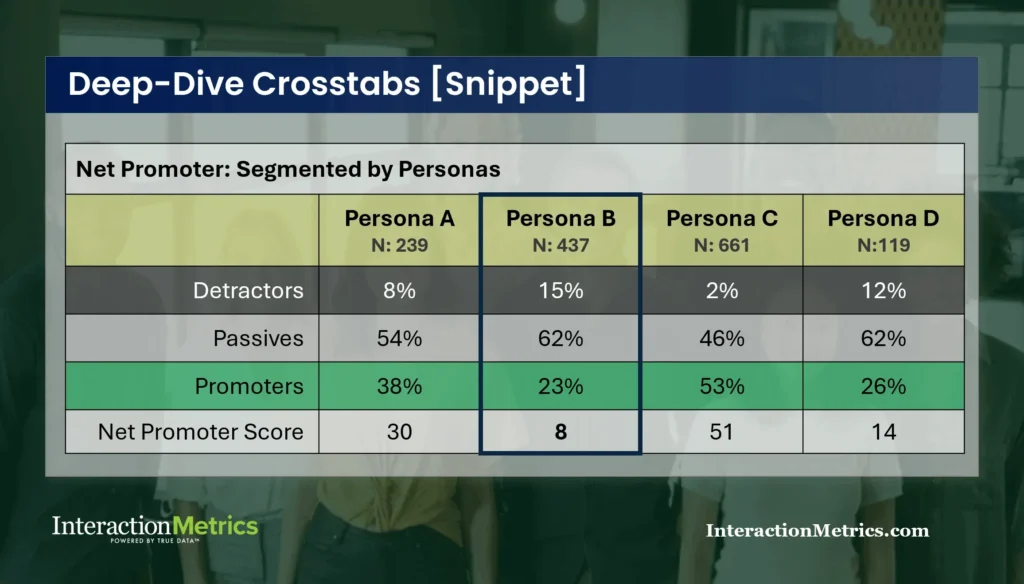
Cross-tabs allow us to compare customer segments side by side. In this example, we show how Customer Types A, B, C, and D rated the company over multiple years. This makes it easy to spot trends in sentiment, track how experiences change over time, and prioritize which customer segments need attention now.
Instead of just seeing your NPS or satisfaction scores, you can see:
- Whether engineers rate your technical documentation lower than buyers do
- Whether longtime customers in the Midwest are more loyal than new accounts on the West Coast
- Which user segments are pulling scores down—and why
Cross-tabs are the engine of behavioral segmentation, enabling you to measure performance in ways that matter.
Using Correlation Analysis to Identify Satisfaction Drivers
Correlation analysis takes segmentation deeper by revealing which elements of the experience drive overall satisfaction within each customer group. For example, our analysis might show that for End Users, training correlates highly with overall satisfaction—while for Distributors, it’s all about availability and ease of ordering.
In the graphic above, we show how ratings for training, engineering, product quality, and other areas correlate with the overall experience. The higher the correlation coefficient, the more that element drives customer sentiment.
This is where your customer data segmentation becomes diagnostic—not just descriptive.
Combining Crosstabs + Correlations = Strategic Power
Used together, cross-tabs and correlation analysis expose not just what customers think—but why.
Let’s say you discover that Customer Type B has lower scores than others. By combining cross-tabs with correlation analysis, we can see exactly which parts of the experience are dragging scores down—and whether those same parts matter as much to other groups.
That’s how we help you avoid wasting time on surface-level trends. Your segmentation analysis becomes a playbook for smart decision-making.
Data That Works with Your Business
Because we embed your CRM data into the results, you’re not limited to basic attributes. We can segment by:
- Customer role (e.g., specifier, installer, buyer)
- Order frequency or spend tier
- Length of relationship
- Specific departments
- Product experience
This is segmentation built for your business, not for software convenience.
Exportable, Sharable, and Built for Action
All of our analyses are exportable—including detailed cross-tabs, correlation heat maps, and dashboards that visualize your customer segmentation models. You’ll get presentation-ready reports and, if needed, raw data files that let you keep analyzing long after the project ends.
This is what sets Interaction Metrics apart as a customer survey company that provides complete CX strategy, not just metrics.
What Segmentation Analysis Can Reveal
Through regular customer segmentation analysis, you can identify:
- Which segments are most loyal—and why
- Where friction is highest in the customer journey
- Which marketing strategies resonate with specific customer segments
- How different groups perceive product quality or service response time
- Where assumptions about “the customer” break down
You may find that one region consistently struggles with product availability, or that customers in a certain segment rate your website experience far lower than others.
These aren’t just anecdotes—they’re trends backed by real data.
Beyond Software: Why Interpretation Matters
Survey platforms offer pre-built segmentation filters. But these filters only scratch the surface.
At Interaction Metrics, we don’t just segment customers based on what’s convenient—we focus on what’s meaningful. Our analysts identify where segments overlap, diverge, or contradict company assumptions. This expert interpretation is what turns data into valuable insights.
You can have all the segmentation data in the world—but without clarity, you’re still guessing.
Aligning Customer Segmentation with CX Strategy
Segmentation should do more than create charts. It should inform how you serve, market to, and develop relationships with your customer base.
For example:
- If loyal customers in Segment A say service responsiveness is critical, prioritize staffing and support.
- If Segment B includes potential customers who value innovation, highlight product development in your marketing campaigns.
- If Segment C is underserved and shows declining satisfaction, investigate internal processes tied to their experience.
This is how segmentation becomes the engine of your customer experience strategy.
Connecting Segmentation to Customer Lifetime Value
Not all segments are equally profitable. Some may generate higher margins or have longer customer lifetime value (CLV). With segmentation analysis, you can align service investments with expected returns—ensuring you don’t over-invest in low-value groups or overlook high-potential customers.
When you align customer segmentation strategy with customer loyalty and CLV, your business grows smarter—not just bigger.
Segmentation for Marketing Teams
For your marketing team, segmentation helps refine messaging, offers, and product positioning. Knowing what different customer segments respond to allows for more targeted marketing efforts, better allocation of your marketing budget, and improved ROI.
That’s why we use tools like brand perception surveys to see how different groups perceive your company—and tailor messaging accordingly.
And because your segmentation is based on real survey data—not guesswork—you avoid chasing trends that don’t matter.
The Role of Market Research in Segmentation
Segmentation without research is like a map without a legend. It’s confusing and potentially misleading.
We combine market research with customer surveys and qualitative methods to ensure your segmentation reflects real-world dynamics—drawing on techniques that move beyond AI to uncover the nuance in customer language. That includes data from focus groups, ethnographic studies, or usage data—depending on your goals.
This is customer segmentation analysis that’s flexible, dynamic, and deeply strategic.
Example: A Segmentation Success Story
Let’s say a company segments its customer base by product type and usage frequency. Through our analysis, they discover that frequent buyers in the industrial sector are experiencing delivery delays—yet still rate the company highly. Why?
Because their account managers are incredibly responsive—something other segments don’t report.
That’s the kind of insight segmentation reveals. It’s not just about who the customers are—but how they feel and why.
Building Long-Term Value through Defined Segments
The goal of segmentation isn’t just better marketing—it’s better relationships. When you understand specific customer groups, you can build programs that serve them better, retain them longer, and turn them into brand advocates.
We help you define, track, and improve these segments over time.
How Often Should You Conduct Customer Segmentation?
The answer: more often than you think. At a minimum, regular customer segmentation analysis should occur once a year. But any time you launch a new product, enter a new market, or see performance shifts, it’s time to revisit your segmentation model.
Segments change. Behaviors shift. Analysis should evolve with them.
Your Segmentation Strategy Should Be Yours
There’s no value in using someone else’s map. That’s why every customer segmentation strategy we build is custom-fit. Whether you need to segment customers based on support usage, brand loyalty, or psychographic data, we tailor everything to your goals.
We’re not here to give you software. We’re here to give you certainty.
Why Choose Interaction Metrics?
As a customer survey company, we don’t just ask questions. We build customer segmentation strategies that align with your CX goals, clarify your blind spots, and help your team take action.
We include:
- Survey design that avoids bias
- Integrated qualitative and quantitative feedback
- Detailed segment reports and dashboards
- Analyst-led debriefs with specific recommendations
This is a survey company for CX, not a platform with generic filters.
Final Thoughts: Make Every Customer Count
Generic solutions ignore what makes your customers unique. But with the right segmentation, you can give each group the experience they deserve—and align your resources where they’ll have the biggest impact.
Let’s turn your customer data into decisions. Let’s create a segmentation strategy that fuels loyalty, efficiency, and growth.
Ready to Go Deeper?
Explore our full customer survey services to see how segmentation fits into a complete CX strategy.
Or learn more about why we’re the trusted survey company for CX for companies that want results—not guesswork.
Your customer data is full of opportunity—if you know where to look.
Let’s uncover the patterns, segments, and strategies that drive growth.
Talk with a CX strategist—not a salesperson.
Frequently Asked Questions
Customer segmentation analysis is the process of dividing your customer base into distinct groups based on shared traits—like behavior, demographics, or lifecycle stage—to uncover how each segment experiences your company.
Because different customer segments often have vastly different expectations. With segmentation, you can tailor your CX strategy to meet the real needs of your most valuable groups—improving satisfaction, loyalty, and efficiency.
Unlike generic dashboards or survey software, our segmentation strategy is built from customer research—not assumptions. We use survey data, behavioral cues, and expert analysis to surface actionable customer insights that drive results.
We analyze all major segmentation types, including behavioral segmentation, demographic segmentation, psychographic, firmographic, and technographic segmentation data—customized to your business goals.
Absolutely. We segment customers based on the criteria that matter most to your operations—whether that’s geographic region, decision-maker role, purchase frequency, or any other key attribute.
We start with expertly designed customer surveys, then layer in behavioral data, purchase history, and demographic data where available. This gives you a 360-degree view of specific customer segments.
Segmenting your customer base helps you understand different needs, improve marketing strategy, prioritize your efforts, and increase customer loyalty. It also allows you to track trends and measure customer lifetime value across segments.
We recommend regular customer segmentation analysis—at least annually or anytime your market, product lines, or customer base shifts significantly.
We’re not just a software platform. As a full-service customer survey company, we handle everything from data collection to expert interpretation—so you get clarity without complexity.
Segmentation is the foundation of any smart customer experience strategy. By understanding your various customer groups, you can tailor support, marketing campaigns, and product development to meet real needs—not assumptions.
More Resources:

How To Calculate Sample Size & Supercharge Your CX Program
Last Updated: January 10, 2025 Key Takeaways: Clients often ask, “How do we get every customer to take our survey?” But here’s the counterintuitive truth: you don’t need everyone’s feedback to get the real picture, which is why today I am addressing how to calculate sample size. Sampling is the art and science of choosing […]

How to Avoid Survey Fatigue
Last Updated: June 16, 2025 Never a day goes by that I don’t receive a survey request—sometimes multiple ones. I bet that’s true for you too. In 2013, SurveyMonkey processed approximately 1 million survey responses per day. By 2014, that number had already more than doubled to 2.2 million per day. And now? By 2025, SurveyMonkey […]

Top Customer Satisfaction Survey Companies of 2026
Last Updated: April 2, 2026 Key Takeaways: A great customer satisfaction survey company does more than send a form and count answers. It helps a business ask better questions, hear the right customers, and understand what the feedback means. The right partner helps you measure customer satisfaction in a way that is credible, useful, and […]

Customer Experience Metrics: How to Measure CX In a Way That Actually Improves It
Last updated: May 4, 2026 Here is a question every CX leader should be able to answer: What did you do differently because of your last survey? If you did nothing, your measurement program is more decorative than real. What goes undiscussed in most CX conversations is that companies aren’t failing because they lack data. […]