TrueData™ SURVEYS
Due Diligence Questionnaires Done Right
We design DDQs, SAQs, and other B2B forms to give you clear insights into vendor risk, fit, and performance.


B2B Survey Experts + Third-Party Objectivity + Software Included
We bring certified CX analysts (CCXP) and proven methods. You’ll have an engaging survey with data you can trust.
We Make DDQ and Other Business Forms Better
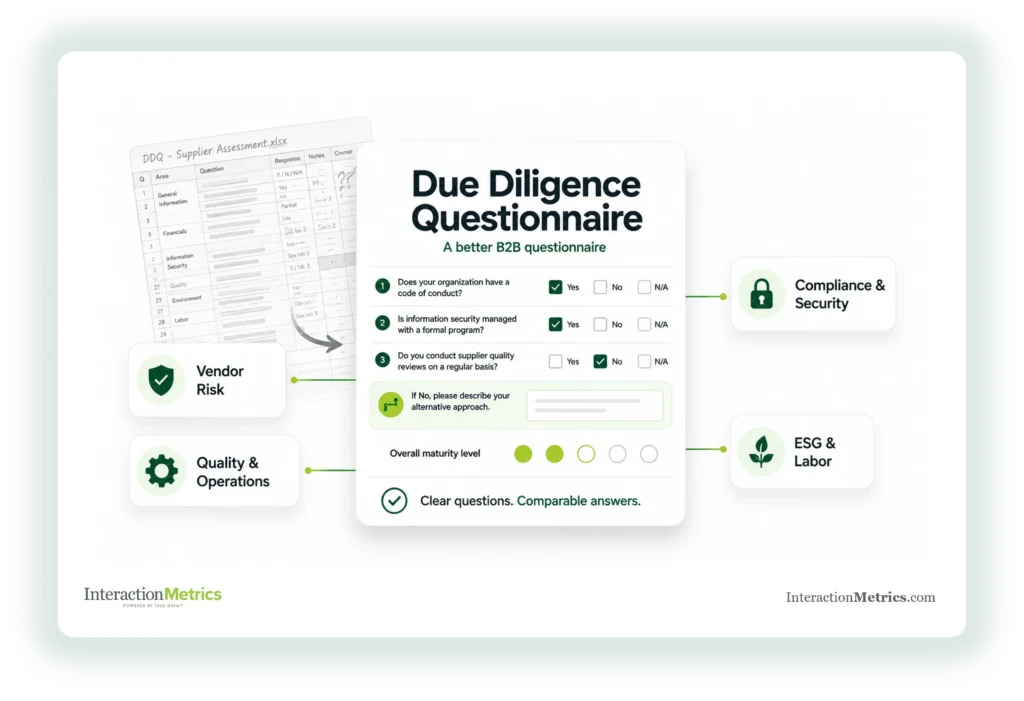
Lots of B2B companies are still sending their Due Diligence Questionnaires and Self Assessment Questionnaires as Excel workbooks. Could that be you? Fourteen tabs, response options that shift between sections, and definitions buried somewhere around row 98. No good.
Vendors dislike filling these forms out. That’s a given. But disliking them isn’t the same as struggling through them, and the struggle is what produces unreliable data.
Our well-designed B2B questionnaires:
- Make it easy for you to compare answers.
- Present your company in a positive light.
- Build trust in the data, because the questions have been objectively vetted for clarity.

Let’s Build the Right Questionnaire for You!
Stop settling for questionnaires that fall short. Let’s build a questionnaire that gives you honest answers, drives action, and accelerates growth.


"*" indicates required fields
Business Case
A manufacturer client inherited a Self-Assessment DDQ from headquarters 5,000 miles away, built around a completely different set of cultural values. The U.S. division ran it through Google Translate. But that didn’t solve the problem. Ninety percent of questions were unclear to vendors, and the whole thing arrived as an Excel workbook.
We rewrote the questions and rebuilt the format. The new version lives online, not in Excel. Vendors preferred it immediately. So did the client.
Results:
- Answers came in 50% faster
- Vendors wrote to thank our client and us, saying they finally understood what they were being asked
- The 139 questions spanned HR, Accounting, Operations, and Leadership, so we designed clean handoffs between teams
TrueData™ Surveys are for B2B Companies
with High-Value Customer Relationships


A good customer survey isn’t one click. It’s dozens of steps.
We handle them all.
Let’s streamline your survey and give you data you can trust.
Built-In Features that Drive Growth

Software included.
No add-on costs. No upsells. No separate licenses. Just results.

Custom design. Bias-free.
Built from scratch to match your goals—no templates, no leading questions, no fluff.

Thematic insights.
Evidence-based, statistically valid data presented in priority order.

Human-coded text analysis + AI.
Every open-ended response coded for nuance and clarity.

Highest response rates!
100% deliverability. 100% engaging. Surveys customers want to take.

CEO-ready Findings Reports.
Action-focused presentations designed for executives and frontline teams.
Trusted by Companies Like Yours
Controlling Risk Helps You Scale
Whether you call the form a BRQ, vendor assessment, or ESG questionnaire, the stakes are the same. Vendors need to share their standards. You need formal documentation of their protocols for labor, security, quality, environmental practices, and more. That documentation helps your company build and scale. It’s also what protects you from vendors who aren’t invested in your core values.
That risk is not theoretical. McKinsey notes that supplier risk often becomes the company’s own risk, especially when organizations lack visibility into supplier vulnerabilities. That’s why the questionnaire itself matters: unclear questions produce unclear data.

We supply the oversight, trust, and alignment that AI can’t.
Use AI where it adds value, lose it where it doesn’t. Built for B2B teams that need survey experts, not another DIY tool.
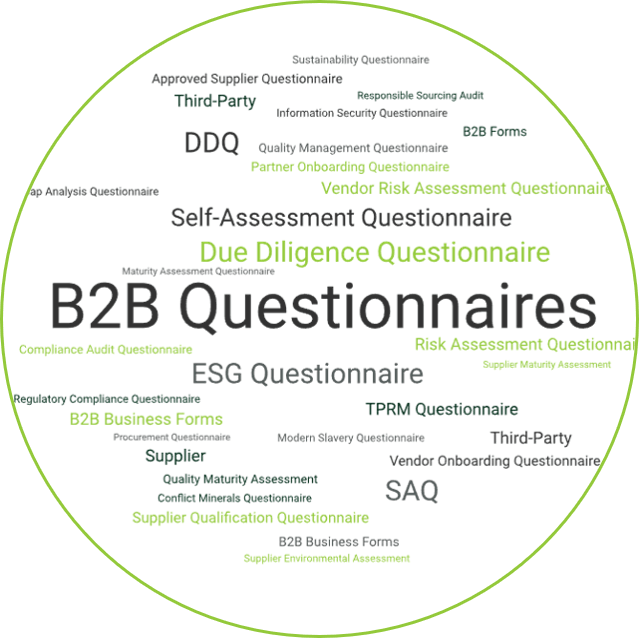
The Types of B2B Questionnaires We Work On
Due Diligence Questionnaires go by many names. The label changes with the industry and the team requesting it. What stays constant is the underlying need: reliable information about a vendor or partner before or during a business relationship.
Deloitte describes third-party risk management as a process that includes sending questionnaires to third parties, scoring their responses, and determining what follow-up is needed. But the value of that process depends on the quality of the questions. If vendors interpret the questions differently, the scoring becomes less reliable.
The categories below cover the extensive list of risk management questionnaires that our team at Interaction Metrics covers.
Risk and Third-Party Oversight Questionnaires
- Due Diligence Questionnaire (DDQ): The umbrella term for vetting a vendor or partner before or during a business relationship.
- Vendor Risk Assessment Questionnaire: Evaluates the operational, financial, and compliance risks a vendor brings to the company.
- Third-Party (Supplier) Risk Assessment Questionnaire: A broader version that covers contractors, partners, and other external parties. Here, the scope varies considerably. Some of our questionnaires focus only on supply chain protocols for Tier-1 suppliers; others reach Tier-2 and Tier-3 to uncover potential adjacent business risks.
- TPRM Questionnaire: Shorthand for third-party risk management. With this questionnaire, we are usually working with compliance and GRC teams.
Qualification and Onboarding Questionnaires
- Supplier Qualification Questionnaire: The purpose of this questionnaire is to vet new suppliers before adding them to an approved list.
- Vendor /Partner Onboarding Questionnaire: Collects operational details, certifications, and capability data as a relationship gets underway.
- Approved Supplier Questionnaire: The form a supplier fills out to earn or keep a spot on an approved list.
- Self-Assessment Questionnaire (SAQ): Asks the supplier to rate their own practices against a defined set of standards. SAQs can apply to any of the questionnaires on this list.
- Supplier Assessment / Vendor Assessment Questionnaire: A general-purpose evaluation across operations, finance, and compliance.
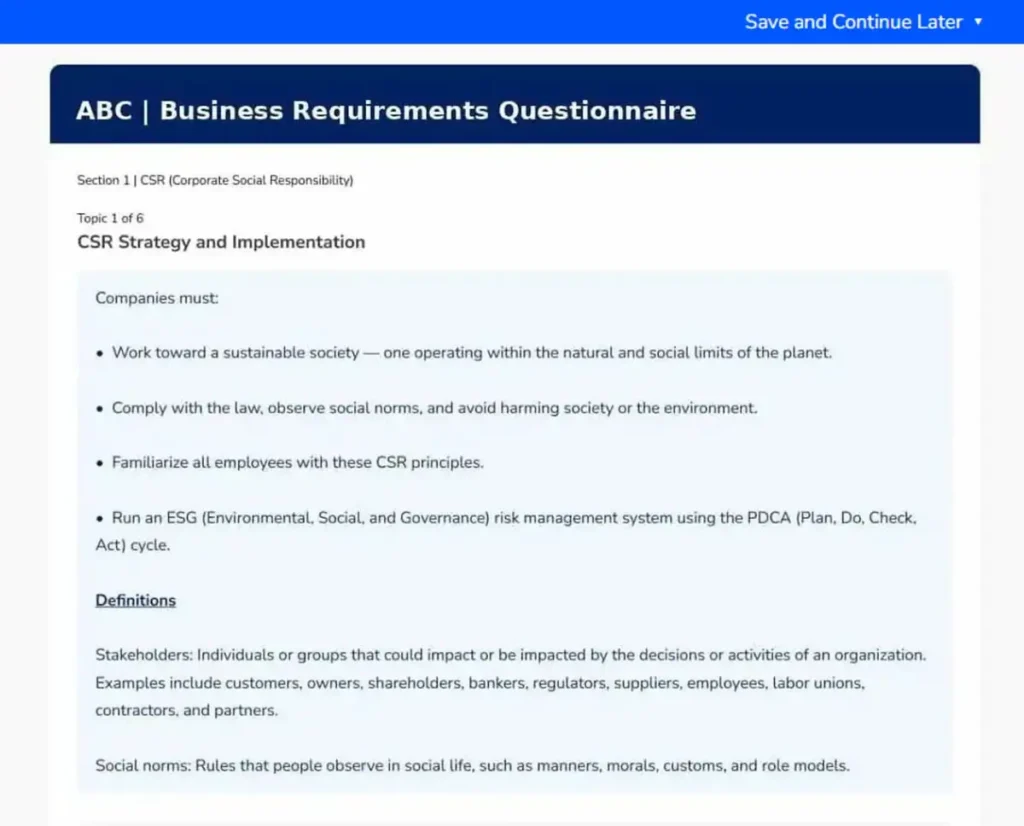
- Business Requirements Questionnaire: Captures the specifications for a specific project or purchase.
Quality Questionnaires
- Supplier Quality Questionnaire: Reviews quality systems, defect rates, and corrective action processes.
- Supplier Quality Audit Questionnaire: We use this during scheduled audits, often tied to ISO 9001 or industry-specific certifications.
- Quality Management Questionnaire: Covers broader quality practices and continuous improvement programs.
- Quality Maturity Assessment: Measures how developed a supplier’s quality function is against a defined model.
Compliance, Regulatory, and Security Questionnaires
- Compliance Audit Questionnaire: Confirms adherence to relevant laws, regulations, and internal policies.
- Regulatory Compliance Questionnaire: The focus is on the specific rules governing the issuer’s industry.
- Gap Analysis Questionnaire: Identifies where current vendor practices fall short of required standards.
- Information Security Questionnaire: Reviews how a vendor handles data, access controls, and incident response.
ESG and Sustainability Questionnaires
- ESG Questionnaire: Covers environmental, social, and governance practices, often aligned with frameworks like GRI, SASB, or CDP.
- Sustainability Questionnaire: Focuses on emissions, resource use, and sustainability reporting.
- Modern Slavery Questionnaire: Required in UK and Australian jurisdictions. Assesses labor practices throughout the supply chain.
- Conflict Minerals Questionnaire: Documents sourcing of tantalum, tin, tungsten, and gold to comply with conflict minerals rules.
- Supplier Environmental Assessment: Covers environmental practices, ISO 14001 status, and impact reporting.
- Responsible Sourcing Audit: A broader review of ethical sourcing covering ESG, labor, and environmental dimensions.
Procurement and Maturity Questionnaires
- Maturity Assessment Questionnaire / Supplier Maturity Assessment: Scores a vendor’s practices against a structured maturity model.
- Procurement Questionnaire: Used by procurement teams to evaluate suppliers in a single instrument.
Whatever form your B2B questionnaire takes, the underlying design problem is the same. Here’s what that looked like for one of our clients.
Let’s Look at Your B2B Questionnaire
If you have a B2B questionnaire that you’re currently running through Microsoft Forms, Google Docs, an Excel workbook, or any other substandard setup, let’s talk. The format matters as much as the questions. A questionnaire built in the wrong tool signals to vendors that your questionnaire isn’t a priority, and that signal shows up in the quality of their answers.
If you already have a professional license with an enterprise survey platform, we’d still like to give your questionnaire a second set of eyes. Most B2B forms have at least a handful of questions that vendors can interpret in at least three different ways. Finding those questions before launch is what separates a questionnaire that produces clean, comparable data from one that produces a spreadsheet full of questionable scores.
Two Ways We Work Together
- Mini-projects. We edit what you have. We review your questions for clarity, bias, and order, then hand back a cleaner version you can deploy yourself.
- Complete programs. We deploy the questionnaire and analyze the results. We design the form, host it on a clean platform, manage vendor outreach, and deliver analysis you can act on.
We’re open to both.
Bottom line: if you have a B2B questionnaire, book a TrueData™ Demo. We’ll show you how we can improve your B2B supplier questions.
Frequently Asked Questions
A Due Diligence Questionnaire is a structured form used to evaluate a vendor, supplier, partner, or third party before or during a business relationship. It typically covers areas such as compliance, security, quality, labor practices, ESG, operations, financial stability, and risk management.
The goal is not just to collect answers. The goal is to get reliable information your team can compare, review, and act on.
DDQs often produce poor data because the questions are unclear, repetitive, overly broad, or difficult to answer. Many are built in Excel, copied from old templates, or written by several departments without a consistent structure.
When vendors interpret questions differently, your team gets messy data. That makes it harder to compare suppliers, identify risk, and decide what follow-up is needed.
A template can be useful, but most DDQ templates are not designed for clean data collection. They may cover the right topics but still ask questions in ways that confuse vendors or make responses hard to compare.
We review your DDQ for clarity, question bias, structure, response options, routing, and usability. We help turn the template into a questionnaire that suppliers can answer accurately and your team can actually use.
Yes. We can work with your existing DDQ, supplier assessment, vendor risk questionnaire, business requirements questionnaire, or compliance form.
We work on DDQs, vendor risk assessments, supplier onboarding questionnaires, third-party risk questionnaires, compliance questionnaires, ESG questionnaires, supplier quality questionnaires, security questionnaires, and business requirements questionnaires.
The names vary by department and industry, but the design challenge is usually the same: ask clear questions, collect reliable answers, and make the data easier to compare.
Timing depends on the length and complexity of the questionnaire. A focused review of an existing DDQ may be handled as a smaller project. A full rebuild with routing, online deployment, vendor outreach, and analysis takes longer.
We scope the work based on the number of questions, departments involved, level of risk, and whether you need help only with design or with the full program.
More Resources:

Rules for Writing B2B Customer Satisfaction Survey Questions
Last Updated: February 10, 2026 Effective B2B customer satisfaction surveys are designed to produce decisions, not just data. To move beyond generic ratings, B2B firms must use role-based routing, suppression strategies, and expectation-gap mapping. This guide outlines the essential rules for transforming B2B surveys into strategic assets that protect revenue and improve customer retention. The […]

The Cost of Customer Satisfaction: B2B Survey Program Costs
Last Updated: February 24, 2025 Key Takeaways: What are typical customer survey program costs? Clients ask this all the time, and the answer varies widely. A simple, off-the-shelf survey might cost very little, while a B2B survey program with multiple customer types, account data, segmentation, and deeper analysis requires a bigger investment. If you’re considering […]

5 Ways B2B CX Stands Apart
In 90 seconds, Kaitlyn Bartley explains 5 ways B2B CX is different. This is an excellent explainer video, click on it above. Want to put these B2B CX truths to work? Read the full report for four practices that will help you improve your customer surveys. Interaction Metrics helps B2B companies uncover the drivers of […]

17 Alternatives To Qualtrics: Key Features & Use Cases Compared
Qualtrics is the industry standard for customer experience surveys. But that doesn’t mean it’s the right fit for everyone. If you’re a large enterprise with a team of analysts and a six-figure budget, it might be perfect. But for most companies? It might be too expensive, clunky, or bloated with features you’ll never use. The […]