TrueData™ SURVEYS
Employee Net Promoter Score: Because Loyalty is Key
Find out if employees would recommend your company and uncover what’s driving their loyalty—or discontent.


B2B Survey Experts + Third-Party Objectivity + Software Included
We bring certified CX analysts (CCXP) and proven methods. You’ll have an engaging survey with data you can trust.
eNPS—Simple yet High Impact
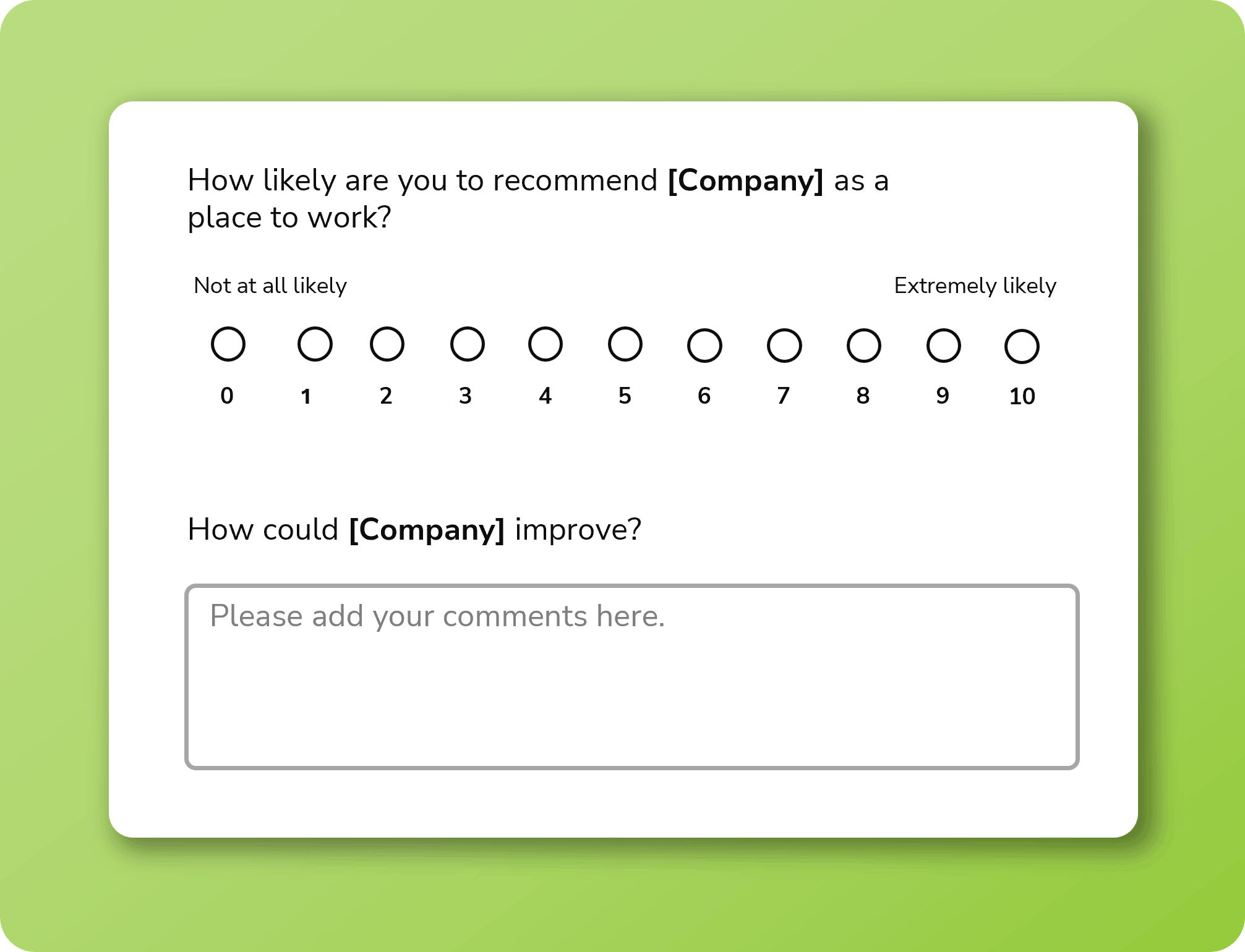
Employee Net Promoter Score (eNPS) asks one simple, high-impact question: Would your employees recommend your company as a place to work? It’s a fast way to gauge loyalty and spot red flags—but it’s not the whole story.
eNPS gives you a quick read on team morale, but not the ‘whys.’ So, let’s use eNPS as a high-level signal, and then dig deeper with the open-ended responses to create an action plan.
Talk to a Survey Expert
The world doesn’t need more customer surveys.
It needs better ones.
Relevant questions ➔ Reliable data ➔ Clear direction.
Curious or have a customer survey challenge? Share a few details. A CCXP-certified survey expert will follow up.


"*" indicates required fields
Loyal Employees Build Loyal Customers
One number can’t explain itself. The score alone can’t tell you why engagement is slipping on one team and climbing on another
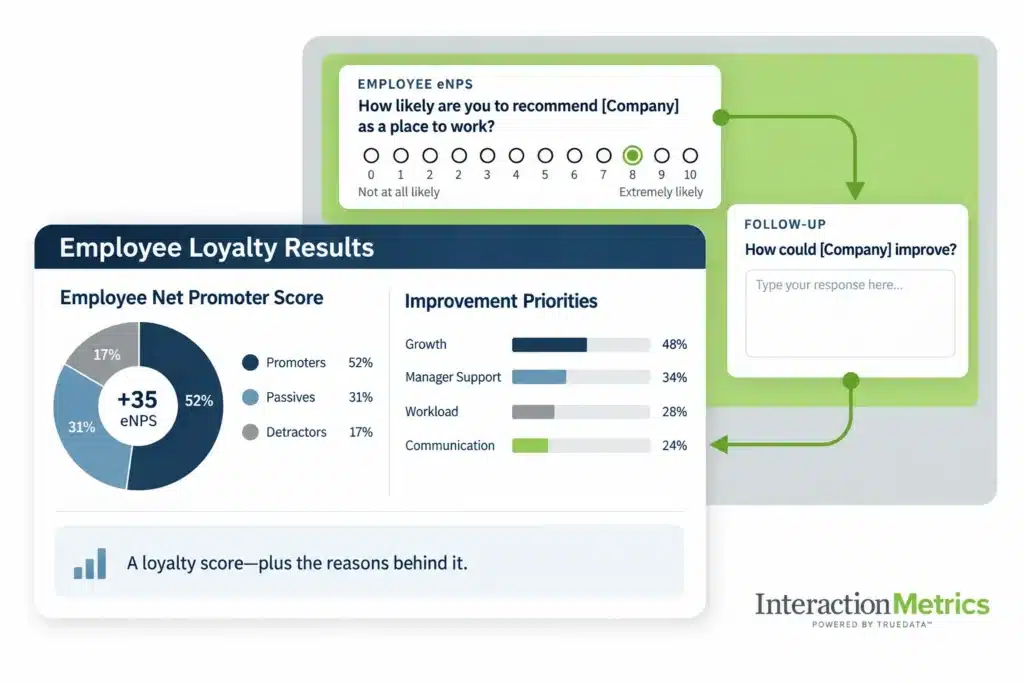
Our reports put every eNPS score in context. You see the trend across quarters. You see the Detractor, Passive, Promoter split. Cut by team and department, and watch the score move.
We write the survey and run the campaign, with real anonymity so employees answer honestly. Our analysts code every open-ended comment against the categories that matter to your business. Then we deliver a CEO-ready Findings Report, grounded in the TrueData™ model.
Interaction Metrics’ eNPS Reports connect employee loyalty to the customer loyalty it drives.
TrueData™ Surveys are for B2B Companies
with High-Value Customer Relationships


A good NPS survey isn’t one click. It’s dozens of steps. We handle them all.
Let’s streamline your survey and give you data you can trust.
Built-In Features that Drive Growth

Software included.
No add-on costs. No upsells. No separate licenses. Just results.

Custom design. Bias-free.
Built from scratch to match your goals—no templates, no leading questions, no fluff.

Thematic insights.
Evidence-based, statistically valid data presented in priority order.

Human-coded text analysis + AI.
Every open-ended response coded for nuance and clarity.

Highest response rates!
100% deliverability. 100% engaging. Surveys customers want to take.

CEO-ready Findings Reports.
Action-focused presentations designed for executives and frontline teams.
Trusted by Companies Like Yours

We supply the oversight, trust, and alignment that AI can’t.
Use AI where it adds value, lose it where it doesn’t. Built for B2B teams that need survey experts, not another DIY tool.
Only Need Software
Level 1
If you already have your survey designed, power it up with the best software and the experts who know how to use it.
$1500-$3000
Complete Design & Deploy
Level 2
All your survey questions, logic flow, rating scales, email campaign, and every other step are managed for you.
$6000-$9900
Get The Analysis Too
Level 3
Crosstabs, correlations, text analysis, dashboards, and findings decks with next-step actions presented to your team.
Avg. $12000-$40000

Need Something More Tailored?
Not every challenge fits neatly into a package. We build custom research and survey strategies for teams with unique goals, complex audiences, or multi-phase initiatives.
eNPS and Sample Follow-Up Questions
The core eNPS question stays constant:
On a scale of 0 to 10, how likely are you to recommend this company as a place to work?
The follow-ups are where most eNPS surveys lose value. “What is the main reason for your score?” produces vague answers. “What would make this company a better place to work?” invites wish-list responses leadership can’t act on. Follow-ups Interaction Metrics writes instead:
- Think about a specific moment in the past month that shaped your score. What happened?
- If a friend was considering a job here, what would you want them to know before they accepted?
- What’s one thing about working here you’d want leadership to keep doing exactly as is?
- What’s one thing that, if it changed, would move your score up by two points?
- For customer-facing employees: in the past month, has anything about your work made it harder to do right by customers?
- Think about the last colleague who left. What was the real reason, in your view?
These are examples, not a template. Every Interaction Metrics survey is custom-built for the company’s industry and goals. Follow-ups designed to surface specifics, not generalities.
What is an Employee Net Promoter Score Survey?
An Employee Net Promoter Score Survey is a simple but revealing tool that measures how likely your employees are to recommend your company as a place to work. It’s fast. It’s efficient. And when used correctly, it’s a window into employee loyalty and the overall employee experience.
The idea comes from the well-known Net Promoter Score used to measure customer loyalty. But in this case, the focus turns inward—on your team. You ask: “On a scale of 0 to 10, how likely are you to recommend us as a workplace?” And then, you let the data speak.
But while many organizations stop there, the most successful ones don’t. They go further, using the eNPS survey as a starting point—not the final word.
How Does an eNPS Survey Work?
The math is easy. After employees respond, you categorize them:
- Promoters (9–10): These are your most loyal team members—your employee advocates.
- Passives (7–8): They’re neutral, but not likely to promote your company.
- Detractors (0–6): These employees may be disengaged—or worse, actively spreading negative word about your company.
To calculate eNPS, you subtract the percentage of detractors from the percentage of promoters. That’s your final score.
For example, if 60% of your team are promoters and 20% are detractors, your eNPS score is +40.
Why eNPS Matters
Your employee net promoter score is more than a number—it’s a signal. A signal that tells you how your culture, leadership, and operations are landing with your people.
Done well, eNPS surveys help HR teams:
- Identify areas of concern
- Uncover employee dissatisfaction
- Detect declines in employee morale
- Track the health of your workplace culture
It’s a fast, cost-effective way to gather employee feedback—especially when you’re committed to regularly measuring eNPS over time.
Where eNPS Shines—and Where It Falls Short
Employee Net Promoter Score surveys are powerful, but they’re not perfect.
They give you a high-level view of how employees feel, but not the full context. That’s why smart organizations pair the promoter score with qualitative follow up questions. Open-ended responses give texture. They help explain the why behind the score.
This is especially important when facing a negative score or receiving a negative eNPS score from a key department. Without deeper analysis, you’re flying blind.
From eNPS to Action: Turning Insights Into Change
The goal isn’t just to know your company’s eNPS—it’s to act on it.
We believe your eNPS survey should go far beyond just calculating a number. It should deliver actionable insights—the kind you can use to improve operations, training, and communication.
After your survey, we’ll show you:
- Trends across departments
- How employee sentiment differs by location or role
- Whether engaged employees align with leadership values
- What’s driving high or low eNPS scores
With this insight, you can move from data to action. And that’s what builds a great workplace.
The Link Between eNPS and Employee Engagement
Employee engagement and employee net promoter score are closely connected—but not interchangeable.
A high eNPS score usually indicates strong engagement. But you still need to look deeper.
Are your employee promoters also high performers? Are they getting the career growth opportunities they need? Do they feel part of a positive work environment?
If you want to improve employee engagement, you need to connect your eNPS feedback with deeper measures of the full employee experience. That’s especially important when you consider what’s at stake—research shows that engaged employees drive higher productivity, better retention, and stronger business outcomes.
In other words, eNPS is a starting point. True engagement takes a more comprehensive strategy.
Measuring Employee Satisfaction? eNPS Is Just the Start.
Can you measure employee satisfaction with one question? Only partly.
The eNPS survey tells you if employees would recommend your company. But it doesn’t tell you if they’re truly generally satisfied—or simply not dissatisfied enough to be detractors.
That’s why we recommend eNPS as part of a layered approach. Start with your employee net promoter score, then use:
- Open-ended comments
- Pulse surveys
- Feedback on company culture
- Data from employee survey results
Together, these tools provide a complete picture of how your people experience your organization.
Anonymous Employee Surveys: Why They Matter
If employees don’t feel safe being honest, your data means nothing.
That’s why every eNPS survey we run is an anonymous employee survey. It’s the only way to surface real employee sentiment, especially among disengaged employees or those considering leaving.
By protecting anonymity, you encourage honest feedback—and prevent the “sugarcoating effect” that leads to misleading higher scores.
Why HR Teams Choose Us for eNPS
Many survey platforms give you a tool—but little else.
We’re different. We run the employee net promoter score survey for you—from design to delivery to analysis. And we go deeper to help HR teams act on what they learn.
That means:
- No software to license
- No dashboards to decode
- Just smart insights delivered in a custom report
We even include a walkthrough meeting with our lead analyst, so you know exactly what your employee feedback is saying—and how to use it to drive business success.
How Often Should You Measure eNPS?
A one-time enps score isn’t enough. Your employee net promoter number should be part of a regular listening strategy.
We recommend quarterly or biannual eNPS surveys to detect trends and intervene before problems escalate. It’s also a great way to see the impact of leadership changes, HR initiatives, or shifts in company culture.
And when combined with enps benchmarks, you’ll be able to compare your final score over time—and against others in your industry.
What’s a Positive eNPS Score?
A positive eNPS score starts at 0—but ideally you’re aiming for +30 or more. Companies with a truly positive work culture often see scores above +50.
That said, scoring isn’t everything. Focus on the why—and whether employees feel heard and supported.
Even a good score can mask hidden dissatisfaction. And even a negative score can be the beginning of a better path forward.
Common Mistakes to Avoid with eNPS
Companies often misuse eNPS in ways that lead to survey fatigue, inaccurate results, or wasted effort. Avoid these missteps:
- Using generic questions that don’t fit your company
- Failing to ask meaningful follow up questions
- Ignoring or under-analyzing open-ended employee responses
- Forgetting to share results—or worse, not acting on them
If you want valuable data, show employees that their voices matter. That’s how you turn a net promoter number into real change.
What Drives Employee Promoters?
High eNPS scores don’t happen by accident. They’re built through:
- Clear communication
- Supportive management
- Opportunities for growth
- Recognition and trust
When these elements are strong, employee promoters thrive—and they tell others. That’s how you build not just engagement, but employee advocacy.
Using eNPS to Drive Business Outcomes
Loyal, engaged employees power better business performance.
They stay longer. They deliver better service. And they build cultures that attract more great people.
By using your employee net promoter score as a guide—not a vanity metric—you can make smarter decisions that drive business outcomes.
It’s not about the number. It’s about the signal.
What Makes Our eNPS Surveys Different?
With us, your employee nps survey isn’t just a quick poll—it’s a full-scale listening strategy.
You get:
- A professionally written employee net promoter score survey
- A secure, anonymous platform
- Insight-rich reporting and enps insights
- Benchmarks and segmentation
- Follow-up strategy and action plan
Our proprietary TrueData™ model filters noise, removes bias, and gets to the truth behind your score—so you can act with confidence.
Ready to Improve Employee Engagement?
If you’re serious about building a great workplace, understanding what drives employee loyalty, and acting on real data—not guesswork—let’s talk.
We design, distribute, and analyze your employee Net Promoter Score survey from start to finish. No software to manage. No guesswork. Just clear, actionable insights delivered securely and professionally.
Let’s turn feedback into focus—and your team into your biggest advocates.
Frequently Asked Questions
Employee Net Promoter Score (eNPS) measures employee loyalty using one question: how likely are you to recommend this company as a place to work? Employees answer on a 0-to-10 scale. The final score, calculated from those responses, ranges from -100 to +100.
To calculate eNPS, subtract the percentage of detractors (0–6 ratings) from the percentage of promoters (9–10 ratings). Passives (7–8 ratings) don’t count toward the score. For example, if 60% of your employees are promoters and 20% are detractors, your final score is +40. This net promoter score is your baseline for employee advocacy and engagement. Use the NPS calculator to work it out for any dataset.
A good score depends on your industry and company size, but generally, anything above 10 is considered positive, and above 30 is strong. The best companies often see higher scores in the 50+ range. But raw numbers don’t tell the full story—context matters. That’s why we pair your eNPS score with qualitative employee feedback and smart follow up questions.
No, and that’s the point. eNPS surveys are great for spotting patterns in employee sentiment, but they’re just one part of a larger employee experience strategy. To truly measure employee satisfaction, you need to understand the ‘why’ behind the score—things like career growth opportunities, company culture, and how employees feel about leadership or workload.
In B2B, employees are the customer relationship. Account managers, sales engineers, customer service reps, and field technicians hold the trust customers spent years building. A drop in eNPS among those employees often shows up in customer renewals six months later. eNPS is an early signal that the customer-facing workforce is shifting, before that shift reaches the renewal conversation. See B2B case studies for examples.
The eNPS question itself is standardized, so AI can produce that part. The problem is everything around it. AI-generated follow-ups tend to be vague (“what would make this a better place to work”), produce wish-lists instead of diagnoses, and miss B2B-specific angles like customer-facing strain. AI also won’t manage anonymity, segment responses meaningfully, or interpret what open-ends actually say. Interaction Metrics uses AI where it adds value, with certified analysts reviewing every survey for bias, alignment, and accuracy. A shortcut isn’t a shortcut if the data is wrong.
We recommend regularly measuring eNPS at least quarterly or twice a year, with pulse surveys in between if leadership wants tighter monitoring. This gives your HR teams a way to track trends, flag shifts in morale, and identify areas needing action. But don’t just track your eNPS—be ready to act on the feedback you receive.
Yes, and they should be. An anonymous employee survey encourages honest feedback, especially when trust is low or when disengaged employees are hesitant to speak up. We build in secure anonymity safeguards so employees can share without fear of backlash, helping you get to the truth.
Employee Net Promoter Score (eNPS) and Net Promoter Score (NPS) follow the same calculation, but one measures employee loyalty and the other measures customer loyalty. NPS tells you how likely customers are to recommend your product or service. eNPS tells you how likely employees are to recommend your company as a place to work.
We manage the entire process—from survey design and tech setup to analysis and reporting. You don’t need to license software or figure out how to measure eNPS on your own. With us, you get:
- Secure, anonymous distribution
- Smartly written follow-up questions
- Segment-based reporting
- Benchmarks and best practices
- A meeting to walk through your results and next steps
More Resources:

Your Employee Engagement Questionnaire: What to Ask
Are you an HR Director, Head of People, HRBP, Chief People Officer, or a business leader responsible for retention and performance? If so, this article is for you, because, presumably, your goal isn’t merely to collect employee feedback and measure employee engagement, it’s to get honest insight you can use. First, let’s start with a […]

5 Quick Tips To Improve Customer Service
Improving customer service is more crucial than ever. Research shows that customers are 2.4 times more likely to stick with a brand when their issues are resolved quickly, yet over half will abandon companies that fail to anticipate their needs. This blog will explore how to improve customer service, common pitfalls to avoid, and metrics […]

How to Increase Survey Response Rate (and Get Data You Can Trust)
Last Updated: May 9, 2025 Getting customers to respond to your survey is harder than ever. You probably skip most of the surveys you’re sent—I know I do. After a trip, I’m flooded with requests from the airline, hotel, and rental car company. I rarely fill them out. If your customers are doing the […]

How To Calculate Sample Size & Supercharge Your CX Program
Last Updated: January 10, 2025 Key Takeaways: Clients often ask, “How do we get every customer to take our survey?” But here’s the counterintuitive truth: you don’t need everyone’s feedback to get the real picture, which is why today I am addressing how to calculate sample size. Sampling is the art and science of choosing […]