TrueData™ SURVEYS
B2B Customer Effort Score Surveys
Pinpoint friction: get your Customer Effort Surveys written, sent, and analyzed, so you’re never guessing where your customers struggle.


B2B Survey Experts + Third-Party Objectivity + Software Included
We bring certified CX analysts (CCXP) and proven methods. You’ll have an engaging survey with data you can trust.
See Where Your B2B Customers Struggle and Why
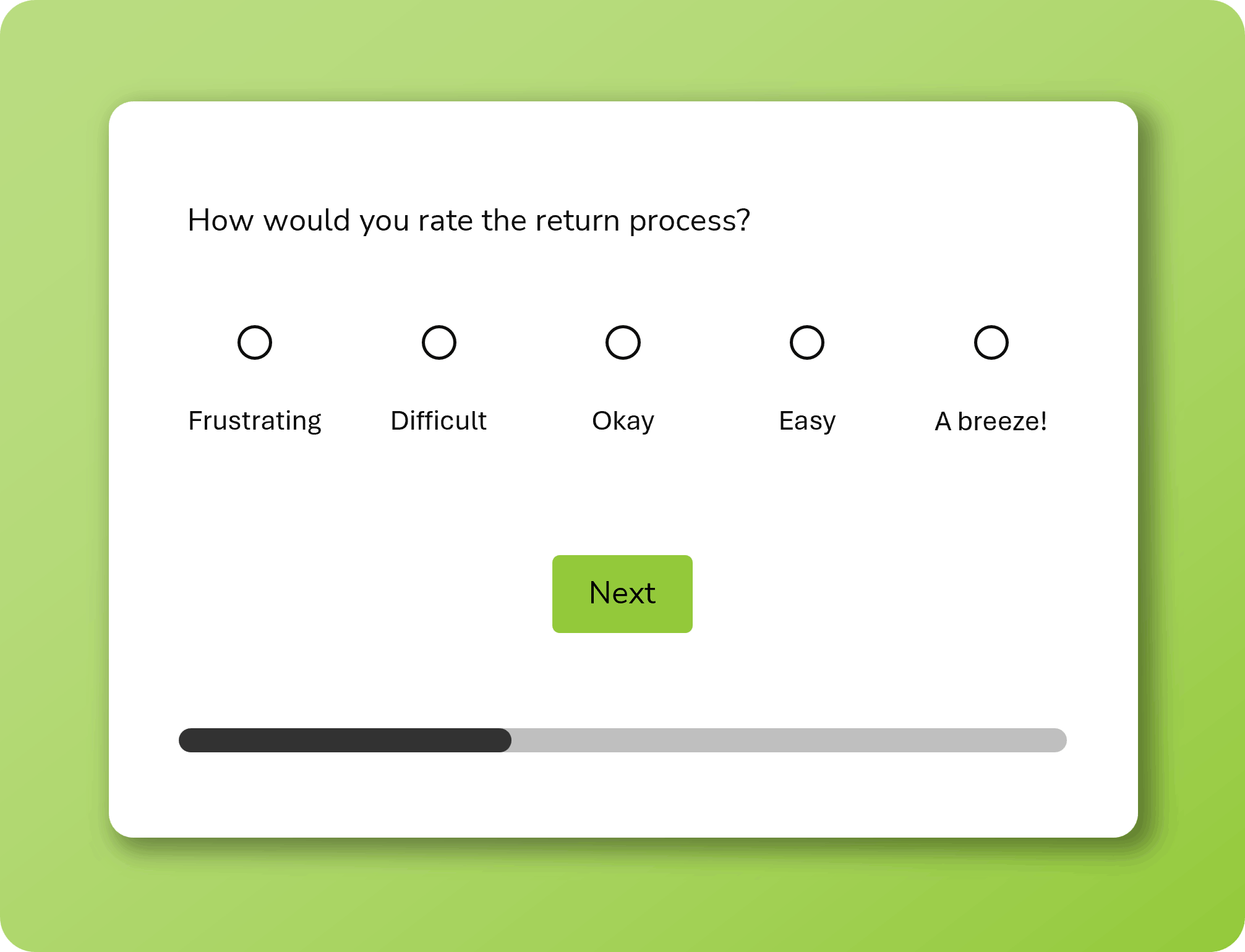
Customer Effort Score (CES) Surveys focus on ease of use: how hard is it for your customers to get what they need from you?
Most CES Surveys ask one question. Ours go further. We measure the real effort customers experience across key interactions, like placing an order, getting support, completing returns, and more.
With this depth, you’ll see where friction lives and why it happens. Plus, you’ll have a composite Customer Effort Score trackable over time and showing what makes your company harder (or easier) to work with.
As a full-service partner, we design the instrument, manage outreach, and segment results to explain the ‘why’ behind effort, so fixes are clear.
Talk to a Survey Expert
The world doesn’t need more customer surveys.
It needs better ones.
Relevant questions ➔ Reliable data ➔ Clear direction.
Curious or have a customer survey challenge? Share a few details. A CCXP-certified survey expert will follow up.


"*" indicates required fields
Get a Prioritized Plan for Reducing Customer Effort
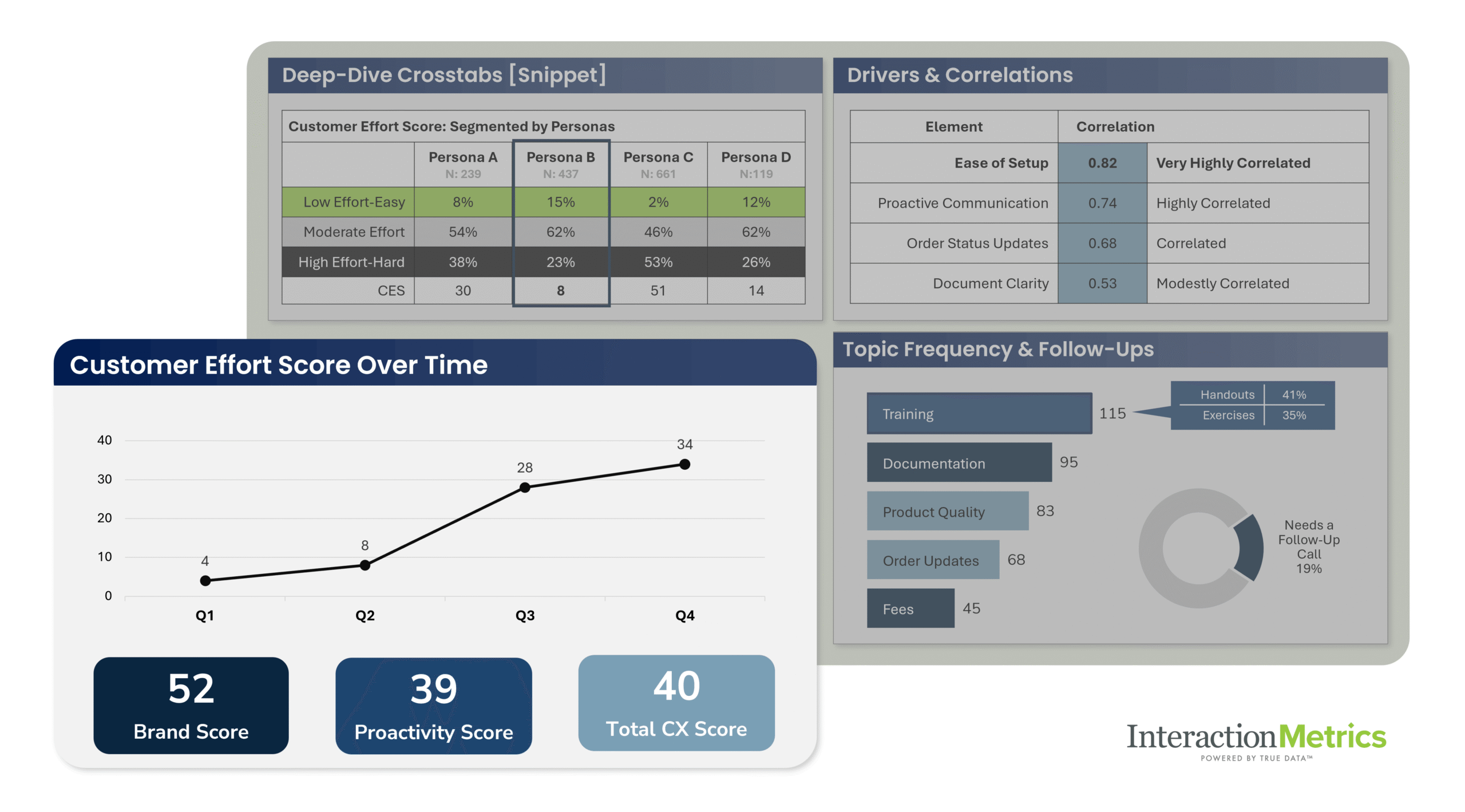
Interaction Metrics turns B2B Customer Effort Score Surveys into a clear view of what’s driving effort and what deserves attention first.
You see Customer Effort Score by persona, the drivers most correlated with effort, quarter-by-quarter movement, and the topics appearing most often, including where follow-up is needed. Brand, Proactivity, and Total CX scores add context.
Our TrueData™ analysis delivers a CEO-ready Findings Report with priorities your team can act on.
See what to fix first, and why.
TrueData™ Surveys are for B2B Companies
with High-Value Customer Relationships


A good customer survey isn’t one click. It’s dozens of steps.
We handle them all.
Let’s streamline your survey and give you data you can trust.
Built-In Features that Drive Growth

Software included.
No add-on costs. No upsells. No separate licenses. Just results.

Custom design. Bias-free.
Built from scratch to match your goals—no templates, no leading questions, no fluff.

Thematic insights.
Evidence-based, statistically valid data presented in priority order.

Human-coded text analysis + AI.
Every open-ended response coded for nuance and clarity.

Highest response rates!
100% deliverability. 100% engaging. Surveys customers want to take.

CEO-ready Findings Reports.
Action-focused presentations designed for executives and frontline teams.
Trusted by Companies Like Yours

We supply the oversight, trust, and alignment that AI can’t.
Use AI where it adds value, lose it where it doesn’t. Built for B2B teams that need survey experts, not another DIY tool.
Only Need Software
Level 1
If you already have your survey designed, power it up with the best software and the experts who know how to use it.
$1500-$3000
Complete Design & Deploy
Level 2
All your survey questions, logic flow, rating scales, email campaign, and every other step are managed for you.
$6000-$9900
Get The Analysis Too
Level 3
Crosstabs, correlations, text analysis, dashboards, and findings decks with next-step actions presented to your team.
Avg. $12000-$40000

Need Something More Tailored?
Not every challenge fits neatly into a package. We build custom research and survey strategies for teams with unique goals, complex audiences, or multi-phase initiatives.
What are Customer Effort Score Surveys?
Customer Effort Score Surveys measure how easy it is for customers to get what they need from your company. Unlike Net Promoter Score, which focuses on sentiment, CES captures real experiences—how much work it took to place an order, get support, or resolve a problem.
And that matters. Because the lower the effort, the higher the loyalty.
Whether you’re looking to improve support, optimize your website, or reduce repetitive tickets, CES Surveys give you the insight to act.
That’s why they’ve become one of the most actionable NPS alternatives—and why we recommend them as a core part of your feedback strategy.
The Customer Effort Score concept was introduced by the Corporate Executive Board (CEB) in a landmark 2010 Harvard Business Review article, “Stop Trying to Delight Your Customers.” Read the article to see the original research on CES and customer loyalty.
Customer Effort Score vs. NPS: What’s the Difference?
CES, NPS, and Customer Satisfaction Scores measure different parts of the customer experience:
- NPS asks: Would you recommend this company to a peer? It captures overall sentiment but doesn’t pinpoint what’s working (or not).
- CES asks: How easy was it to complete your task today? It measures actual experiences and highlights where friction is driving customers away.
Tracking Customer Satisfaction Scores alongside these metrics helps identify immediate issues and improve the overall customer experience.
For B2B, technical services, and industries with long buying cycles, Customer Effort Score often provides more actionable insights than NPS alone.
Both CES and NPS contribute valuable data for understanding overall customer loyalty.
How Customer Effort is Calculated: Your Ease of Doing Business Score
Most CES Surveys ask just one vague question. At Interaction Metrics, we do more.
We calculate what we call your Ease of Doing Business Score—a composite metric based on the actual moments that shape customer friction. Instead of relying on a single number, we gather responses across multiple interactions, then calculate your score using a consistent 1–5 or 1–10 scale, depending on your needs.
This approach reveals where things feel seamless—and where effort is getting in the way.
Examples of touchpoints we evaluate include:
- Website Support: Is it intuitive, fast, and helpful?
- Repair Returns: Are returns easy to initiate and track?
- Inside Sales Knowledge: Do reps understand the products and provide real value?
- Inside Sales Ordering: Is it fast, accurate, and efficient?
- Self-Service Tools: Are your FAQs, chatbots, and help portals clear and useful?
Each example reflects the timeliness, accuracy, and expertise that shape how effortless (or frustrating) your company is to work with.
Once responses are in, we average the scores to calculate your overall Ease of Doing Business Score—and analyze trends using our TrueData™ model. This gives you a powerful benchmark for reducing customer effort, improving operational excellence, and driving retention.
Because when doing business with you is easy, everything else gets easier too—including growth.
Looking to segment these touchpoints by customer type, region, or order size? Our Customer Segmentation Analysis breaks it down even further.
Crafting Effective Customer Effort Score Questions for B2B Relationships
The success of a Customer Effort Score Survey starts with the right questions. We use clear, specific CES questions to pinpoint where effort occurs and what may be causing it.
A well-phrased CES question cuts straight to the customer’s point of view. For example:
- “How easy was it to resolve your issue with our support team?”
- “How much effort did it take to find what you need on our website?”
These types of questions help identify where friction lives in your process. But to get a complete view, it’s critical to go beyond just one score.
That’s why we often pair the core CES question with rating-scale follow-ups (e.g., “Rate the timeliness of our response” or “Rate the clarity of our instructions”) and open-ended prompts like:
- “What made this interaction easy or difficult?”
- “How could we improve this process for you?”
Open-ended feedback reveals why customers found something frustrating, while additional rating questions help isolate specific issues like delays, confusion, or lack of follow-through.
Together, this mix gives you both the quantitative rigor of CES and the qualitative insight needed to take meaningful action—and prioritize improvements based on what actually matters to your customers.
CES Survey Analysis: Make Sense of Your CES Data
Collecting Customer Effort Score data is only step one. The real value lies in interpreting what that data tells you, and translating it into meaningful improvements.
Once your survey responses are in, we calculate your average CES Score. Your score signals ease or unnecessary complexity or frustration.
But the magic happens when we segment that data. We break down scores by interaction type: ordering, website navigation, customer service, etc. This how we show you your high-effort hotspots.
Say checkout has a more problematic CES than returns. That’s a cue to look closer at cart design, payment workflows, or shipping options. Over time, tracking CES data reveals whether your fixes are working and where new friction is emerging.
It’s not just about knowing your score, it’s about understanding why it’s happening and how to reduce effort moving forward.
Turning CES Survey Results into Actionable Insights
The true power of a Customer Effort Score Survey comes from turning results into actionable insights. We start by categorizing CES Survey responses into common themes—such as process friction, unclear communication, or lack of self service options. This helps you see the root causes behind high customer effort and where customers struggle most.
Once we’ve identified these pain points, you’ll develop targeted solutions. For instance, if survey responses show customers have trouble finding information, you might enhance your self service resources or improve website navigation. If the issue is with your customer service team, consider training or process changes.
By using CES data to guide your improvements, you can reduce customer effort, and increase overall customer satisfaction and loyalty. Regularly reviewing and acting on CES Survey results ensures your company stays focused on delivering excellent customer service, while turning insights into measurable progress.
Reduce Customer Effort in High-Value B2B Relationships
Reducing customer effort isn’t just nice, it’s profitable. High-effort experiences lead to frustration, repeat contacts, and churn. Low-effort experiences create loyalty and advocacy. By lowering customer effort, you can significantly improve customer retention and encourage repeat business.
Our CES approach goes beyond the score. We:
- Identify friction points in your service or sales process
- Track ease of doing business over time
- Compare performance across departments
- Uncover patterns that lead to customer complaints
- Quantify the impact of operational changes
- Provide a powerful alternative (or complement) to NPS
- Build and increase customer loyalty by addressing pain points and improving the customer experience
If your goal is to make life easier for customers—and grow your company—Customer Effort Score Surveys are the best place to start.
And with Interaction Metrics, your CES Surveys aren’t just easier for customers—they’re easier for you, too. We design, run, and analyze your surveys using our TrueData™ model, blending AI with expert research.
No guesswork. No extra software to learn. Just clear answers to: How easy is it to work with your company—and how can you make it even easier?
Ready to Make Doing Business with You Effortless?
If your customers are struggling, we’ll help you find out where—and why. With professionally written surveys, advanced analysis, and zero software to manage, our Customer Effort Score programs show you the exact friction points holding your company back.
- Composite Customer Effort Score tracked over time
- Full-service execution and TrueData™ analysis
- Clear steps to reduce friction and boost retention
Let’s make your customer experience smoother, smarter, and more competitive.
Bottom line: do you have a current survey? Get a free survey audit. We’ll examine your survey and tell you whether you’re in a good place or how to improve.
Frequently Asked Questions?
A CES Survey measures how easy it was for a customer to complete a specific interaction: resolve an issue, place an order, get an answer. CES is one of the most predictive metrics for retention and churn because it captures friction in the moment it happens.
Net Promoter Score (NPS) asks whether someone would recommend the company. Customer Effort Score (CES) asks how hard it was to get what they needed. CES is often a better real-time signal for service improvements because it ties directly to a specific interaction, while NPS measures overall loyalty.
Customer Satisfaction (CSAT) measures whether the customer was satisfied. Customer Effort Score (CES) measures how much effort it took them. Two customers can be equally ‘satisfied’ but have very different effort scores, and the customer with higher effort is more likely to churn, even if they didn’t complain.
Send CES after key moments in the customer journey: support calls, repair requests, online transactions, self-service interactions. Anywhere a customer has to navigate a process. CES should be measured at multiple journey points because effort can vary across channels.
High contact volumes, repeated questions, abandoned carts, negative reviews. These often trace back to effort the customer didn’t sign up for. A CES Program makes those issues measurable and prioritizable.
We combine quantitative CES Scores with open-ended comments. Using our TrueData™ model, we find patterns in customer friction and translate them into prioritized improvements. The team gets a benchmark, a trendline, and a list of fixes ranked by impact.
More Resources:

What Is Customer Effort Score (CES) & Why Does It Matter?
Customer Effort Score (CES) measures how hard it is for your customers to get help from your customer service teams. And if you’ve ever had a hard time canceling a subscription or fixing a billing issue, you know exactly why it matters. Has this ever happened to you? You clicked through five help articles, waited […]

How to Increase Customer Retention: 15 Proven Strategies That Work
What Is Customer Retention and Why Does It Matter? Customer retention may sound like business jargon, but really, it’s just the art of keeping your customers happy enough that they stick around. Think about your favorite coffee shop. Maybe they offer you a punch card where you earn a free coffee after ten purchases. That’s […]

Top Customer Satisfaction Survey Companies of 2026
Last Updated: April 2, 2026 Key Takeaways: A great customer satisfaction survey company does more than send a form and count answers. It helps a business ask better questions, hear the right customers, and understand what the feedback means. The right partner helps you measure customer satisfaction in a way that is credible, useful, and […]

How To Calculate Sample Size & Supercharge Your CX Program
Last Updated: January 10, 2025 Key Takeaways: Clients often ask, “How do we get every customer to take our survey?” But here’s the counterintuitive truth: you don’t need everyone’s feedback to get the real picture, which is why today I am addressing how to calculate sample size. Sampling is the art and science of choosing […]