TrueData™ SURVEYS
Employee Satisfaction Surveys: Keep Tabs on Staff Contentment
Measure how content employees are with their role, compensation, and environment—before staff start listening to recruiters.


B2B Survey Experts + Third-Party Objectivity + Software Included
We bring certified CX analysts (CCXP) and proven methods. You’ll have an engaging survey with data you can trust.
Measuring Employee Satisfaction
Employee Satisfaction Surveys are your go-to for measuring staff happiness: Do employees like their job? Their manager?
These surveys help you track the basics, such as perceptions of compensation, workload, and daily kick-off meetings.
Think of Employee Satisfaction Surveys as your tool for spotting discontent and preventing turnover before it starts.
Talk to a Survey Expert
The world doesn’t need more customer surveys.
It needs better ones.
Relevant questions ➔ Reliable data ➔ Clear direction.
Curious or have a customer survey challenge? Share a few details. A CCXP-certified survey expert will follow up.


"*" indicates required fields
Don’t Just Buy a Survey Platform. Get a Partner.
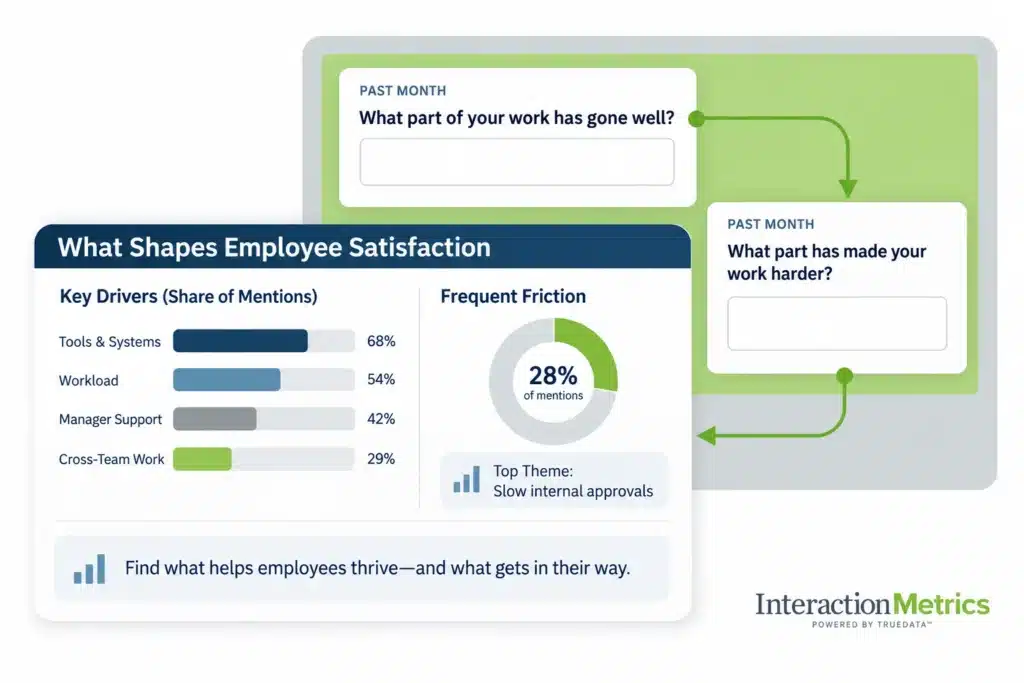
The score tells you people are unhappy. It can’t tell you why, or who’s about to walk. Our reports put it in context. You see satisfaction move across quarters, the issues employees raise most, and how it differs by team and department.
We write the survey and run it with real anonymity, so employees answer honestly. Our analysts read every open-ended comment and surface the themes behind the score. Then we deliver a CEO-ready Findings Report, grounded in the TrueData™ model.
Interaction Metrics’ Employee Satisfaction Reports show you where discontent is building, before it turns into turnover.
TrueData™ Surveys are for B2B Companies
with High-Value Customer Relationships


A good employee survey isn’t one click. It’s dozens of steps.
We handle them all.
Let’s streamline your survey and give you data you can trust.
Built-In Features that Drive Growth

Software included.
No add-on costs. No upsells. No separate licenses. Just results.

Custom design. Bias-free.
Built from scratch to match your goals—no templates, no leading questions, no fluff.

Thematic insights.
Evidence-based, statistically valid data presented in priority order.

Human-coded text analysis + AI.
Every open-ended response coded for nuance and clarity.

Highest response rates!
100% deliverability. 100% engaging. Surveys customers want to take.

CEO-ready Findings Reports.
Action-focused presentations designed for executives and frontline teams.
Trusted by Companies Like Yours

We supply the oversight, trust, and alignment that AI can’t.
Use AI where it adds value, lose it where it doesn’t. Built for B2B teams that need survey experts, not another DIY tool.
Only Need Software
Level 1
If you already have your survey designed, power it up with the best software and the experts who know how to use it.
$1500-$3000
Complete Design & Deploy
Level 2
All your survey questions, logic flow, rating scales, email campaign, and every other step are managed for you.
$6000-$9900
Get The Analysis Too
Level 3
Crosstabs, correlations, text analysis, dashboards, and findings decks with next-step actions presented to your team.
Avg. $12000-$40000

Need Something More Tailored?
Not every challenge fits neatly into a package. We build custom research and survey strategies for teams with unique goals, complex audiences, or multi-phase initiatives.
Sample Employee Satisfaction Survey Questions
Satisfaction surveys cover themes including:
- Role and responsibilities
- Compensation and benefits
- Manager support
- Workload and pace
- Tools and systems
- Recognition
- Cross-team collaboration
- Growth and development
- For B2B: whether internal conditions help employees do their work for customers
Most satisfaction surveys ask about these themes the wrong way. “How satisfied are you with X?” repeated across ten topics produces flat, agreeable data that doesn’t tell leadership what to act on. Questions Interaction Metrics writes for B2B satisfaction surveys instead:
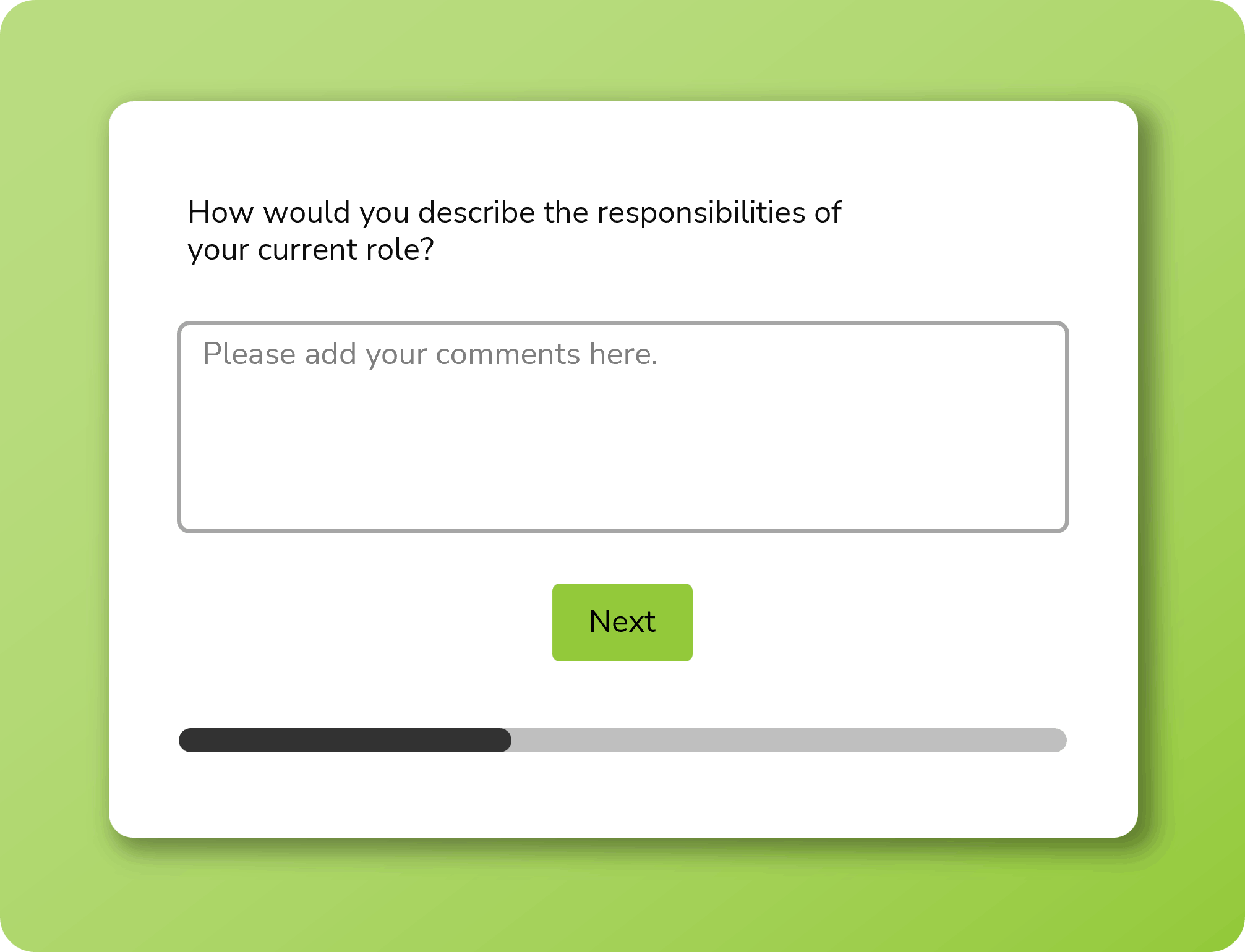
- Thinking about the last month, what part of your role has worked well and what part hasn’t?
- The last time you needed support from your manager, how did that go?
- In a typical week, how often do the tools or systems you use add time to your work?
- The last time you got recognition at work, what was it for and where did it come from?
- When you need to work with another department to get something done, what typically happens?
- The last time a customer needed something outside your usual process, what did it take to handle it?
- If you were considering a job offer from another company, what about your current role would weigh against leaving?
These are examples, not a template. Every Interaction Metrics survey is custom-built for the company’s industry and goals. No leading language. No social desirability traps.
How Satisfaction Surveys Help Human Resource Management
Today’s HR leaders wear many hats. From recruiting and compliance to wellness and succession planning, the demands on HR teams have never been higher. Satisfaction surveys are a powerful tool to support human resource management by surfacing data HR can use to advocate for change.
Say HR wants to invest in a new recognition program. If the satisfaction survey shows employees don’t feel appreciated, that’s strong justification for the investment. Similarly, survey findings can help secure executive buy-in for policy changes, leadership training, or technology upgrades.
When HR can point to real employee feedback—and not just anecdotal complaints—they gain the leverage needed to make strategic improvements.
Do Most Employees Participate in Satisfaction Surveys?
Participation is always a concern. But with the right design and communication strategy, most employees do respond to satisfaction surveys—especially when they believe their voices will lead to change.
We help boost participation through smart timing, mobile-friendly formats, and messaging that reinforces anonymous feedback. Employees are far more likely to share when they understand their responses are confidential and will be used constructively.
If you’ve had low response rates in the past, don’t worry. We can help identify where things went wrong—and build a process employees trust.
How Many Employee Responses Do You Really Need?
Once your survey questions are set, the next big question is: how many employees need to respond for your results to be valid?
Too few, and your findings won’t represent the broader team. Too many, and you’re wasting effort without improving accuracy.
Insights From Former Employees
While most satisfaction surveys focus on current staff, there’s value in looking at former employees too. Their feedback—often gathered through exit interviews or post-departure surveys—can validate internal trends and reveal why certain issues were never voiced internally.
When appropriate, we can include this dimension in your broader employee survey strategy, particularly if you’re concerned about employee turnover or loss of institutional knowledge.
Regular Satisfaction Surveys Keep Trends Visible
Running your first employee satisfaction survey is a great starting point—but it shouldn’t be the last. To capture shifts in sentiment, we recommend implementing regular satisfaction surveys that align with key organizational milestones or annual planning cycles.
Frequent check-ins—especially when tied to action—reinforce that the organization cares. They also show employees that your culture isn’t static but evolving.
And remember: when you measure early and often, you prevent minor frustrations from turning into full-blown disengagement or attrition.
How We Analyze and Share Satisfaction Data
Satisfaction surveys generate valuable data—but without clear reporting, that data becomes noise. That’s why we turn your survey results into clean, visual reports your team can actually use.
You’ll receive:
- A satisfaction score with internal and industry benchmarks
- Trends by team, tenure, and department
- Visual dashboards that highlight key issues
- Written summaries and priority flags for immediate action
You’ll also get access to our reporting portal—a secure, user-friendly platform where your results are organized and always available.
Whether you’re preparing for a board meeting or coaching a department head, our reports make it easy to translate survey findings into meaningful decisions.
Tracking the Impact of Action
One of the most powerful use cases for satisfaction surveys is tracking progress over time. For example, say you address concerns about workload or unclear communication—how will you know if those changes made a difference?
That’s where follow-up surveys come in. By measuring again, you can see whether employees feel more supported, valued, or clear in their roles.
This creates a feedback loop—listen, act, re-measure—that fuels continuous improvement.
When employees see that their input leads to real action, morale goes up. Trust strengthens. And small wins begin to scale into lasting business change.
Connecting Satisfaction to Engagement and Retention
High satisfaction supports employee engagement, and engaged employees are more likely to stay. While these may seem like soft metrics, their impact on operations and growth is substantial.
Reduced employee absenteeism rate, fewer performance management issues, and better cross-functional collaboration are just a few of the outcomes companies report when satisfaction scores rise.
And because engaged, satisfied employees are more likely to refer others, satisfaction becomes a recruiting advantage too.
Employee Satisfaction and the Productive Workforce
Think of employee satisfaction as fuel for a productive workforce. When employees are content, focused, and respected, they waste less time navigating politics or policies—they get to work.
Satisfaction influences everything from meeting productivity to creativity to conflict resolution. That’s why companies with consistently high scores tend to outperform peers across multiple performance indicators.
Telling the Story Behind the Numbers
Satisfaction surveys are data—but they’re also stories. Through both numbers and narratives, you get a vivid picture of what it’s like to work inside your company.
Our reports combine metrics with context. For example, a department might score low on job satisfaction, but the comments reveal the issue is actually a confusing workflow—not the job itself. That distinction helps you address concerns more effectively and avoid false assumptions.
This is the difference between raw survey data and insights you can act on.
Can a Satisfaction Survey Improve Business Success?
Yes. In fact, companies that measure employee satisfaction consistently and act on findings outperform competitors on multiple dimensions of business success—including revenue growth, profit per employee, and customer satisfaction.
According to SHRM research, companies with satisfied employees consistently report higher customer satisfaction and better business performance.
That’s because satisfied employees are more likely to:
- Stay with the company
- Speak positively about the brand
- Help new hires succeed
- Provide better service
In short, satisfaction isn’t just an HR metric—it’s a business one.
What About Sensitive Topics like Poor Working Conditions?
A common concern is how to explore difficult subjects, such as poor working conditions or interpersonal conflict. That’s where our experience comes in.
We design surveys with sensitivity and nuance. Employees are given structured prompts and the freedom to provide honest feedback without fear of retaliation. When those issues are surfaced carefully, leadership can act on them swiftly and constructively.
We also ensure questions avoid bias that might distort or downplay real issues, because even subtle wording can shut down honest responses.
We help you identify the real pain points while protecting the employee-employer relationship.
Why You Need a Satisfaction Strategy Now
The future of work depends on listening. And not just to the loudest voices—but to all of them. From new hires to senior contributors, every employee’s experience matters.
Whether you’re launching your initial survey or expanding your listening program, our approach ensures you’re not just asking questions—you’re building trust, making progress, and delivering the kind of workplace culture employees want to be part of.
Ready to Measure—and Improve—Satisfaction?
At Interaction Metrics, we specialize in employee and customer feedback programs that go beyond the basics. As your employee survey company, we’ll design a custom, science-backed approach to help you improve employee satisfaction, reduce turnover, and grow a more productive workforce.
Frequently Asked Questions
An employee satisfaction survey is a structured questionnaire that measures how content employees are with aspects of their job—such as their role, compensation, manager, and work environment. It’s a key way to identify what’s working and where dissatisfaction may lead to turnover or disengagement.
To measure employee satisfaction, we use a mix of quantitative questions (e.g., rating compensation or job duties) and qualitative feedback (open-ended responses). Our surveys are structured to capture what employees feel, why they feel it, and how those sentiments impact satisfaction, morale, and retention.
Employee satisfaction reflects how content employees are with their current situation. Employee engagement, on the other hand, measures how emotionally invested and motivated they are in their work. Both are essential, but satisfaction is the foundation—you can’t have truly engaged employees without satisfied employees first.
DIY tools give you forms. As a full-service employee survey company, we provide strategy. We design unbiased surveys, ensure anonymity, analyze employee sentiment, and give you actionable insights—not just raw data. Plus, we hold licenses to the best platforms, so you avoid software costs and learning curves.
That depends on your goals. Many companies start with a baseline employee satisfaction survey, then follow up with pulse surveys quarterly or biannually. We’ll help you build a cadence that avoids survey fatigue while still keeping a close eye on employee sentiment and workplace morale.
We tailor your survey to your goals, but common employee satisfaction survey questions include:
- Do you feel recognized for your work?
- How would you rate the company culture?
- Do you believe the current benefits package meets your needs?
- What could improve your daily experience?
Anonymity is critical for collecting honest feedback. We use licensed platforms with strict confidentiality protocols and communicate clearly with employees that their responses are protected. Employees are more likely to share openly when they know their answers can’t be traced back to them.
After data collection, we analyze both the numbers and the narratives. You’ll receive a satisfaction index, department comparisons, and a clear summary of what to prioritize. We’ll walk you through your results—and, if desired, help you develop a retention or engagement action plan.
Yes. We can integrate employee satisfaction, employee engagement surveys, and even employee Net Promoter Score (eNPS) to give you a multidimensional view of workplace sentiment. Comparing these metrics helps pinpoint whether issues stem from motivation, culture, compensation, or leadership.
High employee satisfaction is directly linked to employee retention. By identifying what drives discontent—like poor management, low recognition, or lack of career growth—you can proactively improve the work environment before employees disengage or quit.
Absolutely. Every employee satisfaction survey we deliver is customized to your business, your goals, and your culture. Whether you want to focus on job satisfaction, work-life balance, or how employees feel about a recent policy change, we tailor the survey questions accordingly. Customization ensures you get valuable insights that align with your priorities—not generic benchmarks.
More Resources:

Top Customer Satisfaction Survey Companies of 2026
Last Updated: April 2, 2026 Key Takeaways: A great customer satisfaction survey company does more than send a form and count answers. It helps a business ask better questions, hear the right customers, and understand what the feedback means. The right partner helps you measure customer satisfaction in a way that is credible, useful, and […]

How To Calculate Sample Size & Supercharge Your CX Program
Last Updated: January 10, 2025 Key Takeaways: Clients often ask, “How do we get every customer to take our survey?” But here’s the counterintuitive truth: you don’t need everyone’s feedback to get the real picture, which is why today I am addressing how to calculate sample size. Sampling is the art and science of choosing […]

How to Avoid Survey Fatigue
Last Updated: June 16, 2025 Never a day goes by that I don’t receive a survey request—sometimes multiple ones. I bet that’s true for you too. In 2013, SurveyMonkey processed approximately 1 million survey responses per day. By 2014, that number had already more than doubled to 2.2 million per day. And now? By 2025, SurveyMonkey […]

Email Survey Best Practices
Your Reply-To Address Matters! An essential email survey best practice is this: Use a Reply-To email address that actually works. Too many companies send surveys from a Do-NOT-Reply address which frustrates customers and lowers response rate. At Interaction Metrics, we develop surveys, launch them, and make sense of the data—using a reply-to email address […]