TrueData™ SURVEYS
B2B Survey Best Practices
Take our 8-question quiz to determine whether your surveys have gaps.


B2B Survey Experts + Third-Party Objectivity + Software Included
We bring certified CX analysts (CCXP) and proven methods. You’ll have an engaging survey with data you can trust.
Survey Best Practices: 8-Question Quiz
Most companies send surveys. But few take the time to evaluate whether those surveys are working. This tool assesses how well your surveys follow proven survey best practices, so you can build trust, increase response rates, and get actionable insights from the data you collect. Each question targets a specific are of how your surveys are built: from question wording through open-ended feedback.
What Your Score Means
Your score points to the strengths and gaps in how you run surveys. Whether you scored high or low in the quiz above, the answers below explain the reasoning behind each option: why the practice matters and where it fits in the survey process.
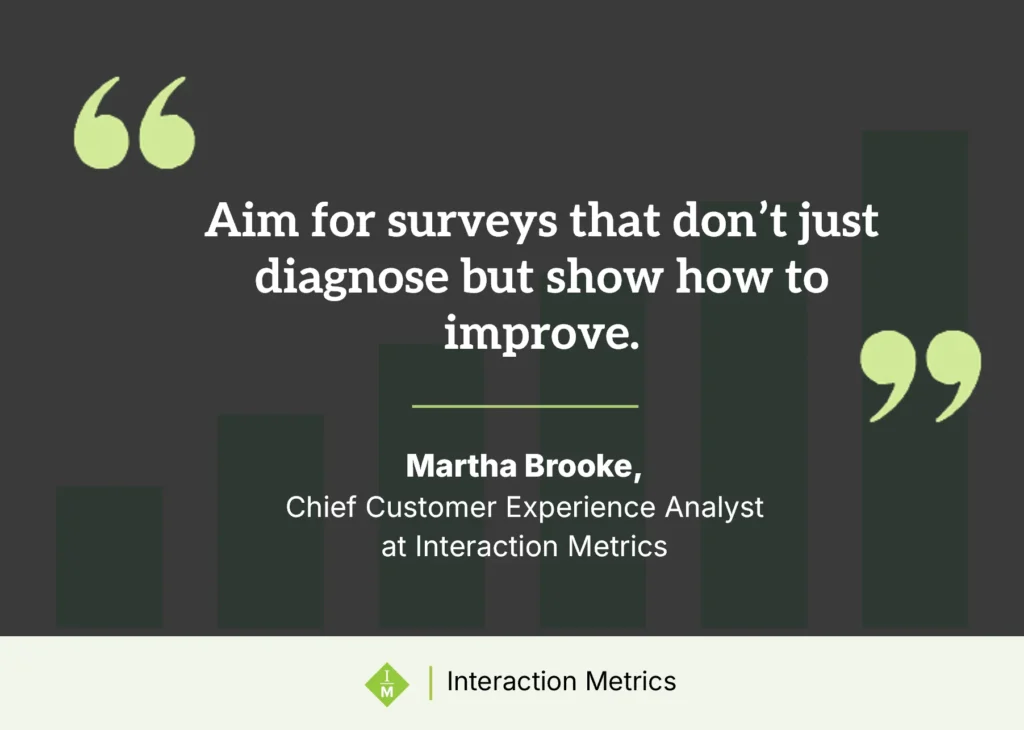
Most survey programs tell you what’s wrong and stop there. Interaction Metrics doesn’t. Chief Customer Experience Analyst Martha Brooke puts it simply: “Aim for surveys that don’t just diagnose but show how to improve.” Every project runs on that principle.
Best Practices–Best Answers!
#1. How do you remove bias from your surveys?
Best Answer: An outside team systematically removes leading or loaded language.
An internal review reliably catches typos and rarely catches bias, and the reason has nothing to do with how sharp the reviewer is. The wording that nudges a respondent toward an answer is usually the wording that felt most natural to write, so the colleague reading the draft is reading it with the same assumptions that produced it. They approve the leading question for the same reason it got written. Systematic outside review works because the reviewer has no investment in the answer coming back a particular way.
How bias creeps into surveys →
#2. Does your survey allow for anonymity?
Best Answer: Yes
Without the option, you lose respondents in two directions at once. Some soften what they say, which inflates the scores. Others skip the survey, which distorts who’s in the sample. Anonymity doesn’t make anyone honest by itself, but withholding it costs you candor, and in B2B, where the person answering knows the account manager by name and expects to be on a call with them next quarter, the cost is considerable.
Learn how anonymity reduces drop-off and helps you avoid survey fatigue →
#3. How do you ensure representative response? (Check all that apply)
Best Answer: Boost outreach AND use sampling and weighting.
Whoever happens to answer is not the same group as the one you needed to hear from. Left to itself, a survey collects responses from the people with the strongest feelings in either direction, and a program built on their answers gets designed for the extremes. Consumer research absorbs this through sheer volume. A B2B program running against forty accounts has no volume to absorb anything with, which is why representativeness has to be engineered before the survey goes out rather than assessed after it closes.
Read how to increase survey response rates →
#4. For your quantitative analysis, what do you use? (Select all that apply)
Best Answer: All of these:
- Crosstabs to reveal patterns across segments (e.g., customer type, region)
- Correlation analysis to identify meaningful relationships
- Simple metrics like NPS or Effort Score for top-level reporting
- Weighted scoring to reflect what matters most to customers
- Benchmarking against past results or industry standards
Reporting a metric and analyzing data are different activities that tend to get filed under the same name. The score tells you where you landed. Crosstabs tell you who’s pulling it down, correlation tells you which parts of the experience are actually moving it, weighting keeps the dimensions customers care about from being averaged against the ones they don’t, and benchmarking tells you whether the number was any good to begin with. Run only one of these and most of the information stays on the table.
Blending qualitative + quantitative analysis →
#5. How do you analyze open-ended feedback?
Best Answer: Combine AI with critical thinking to capture context, emotion, and nuance.
Open-ended responses hold the reasons behind every score in the survey, which is why the method matters more here than anywhere else in the analysis. AI clusters quickly and reads shallowly. It will return the five most common themes ranked by frequency, as though frequency and importance were the same measurement. What it won’t do is read across the responses and notice that three accounts reached for the same odd phrase to describe a problem nobody has named yet. That reading is still human work.
See how to get real value from open-ended feedback →
#6. What describes your survey invite approach?
Best Answer: Email invite includes a reply-to address, giving customers a way to share input beyond the survey.
The invitation is the first thing you ask a customer to evaluate, whether you intended it that way or not. A message from no-reply@ tells them the exercise is a form to be completed rather than a conversation someone will read, and they answer it in that spirit. A live reply address costs nothing and changes what comes back. So does saying plainly that you want the criticism and not only the praise.
See how your email practices reflect your listening culture →
#7. How do you handle Findings Reports and presentations?
Best Answer: A dedicated team presents insights clearly and visually.
The most common end state for a survey program is a dashboard everyone has access to and nobody opens. That’s a translation failure rather than a reporting one, because the data is present and correct and organized for the person who collected it instead of the person who has to do something about it. A findings report earns the name when the operations lead can read it and know what changes on Monday, which is a different document from the one the CEO needs to see.
See how to make your dashboard truly work →
#8. Finally, how would you describe your customer listening approach?
Best Answer: Customized questions uncover the details of customers’ challenges and experiences.
Sending the same templated survey every quarter does produce a trend line, and a trend line is worth having. The problem is a program where the template is all there is, since it can only ask about what mattered on the day someone wrote it. Programs that work hold a core set of questions steady so the tracking survives, then rotate the rest to match what’s actually happening in the business. Strategic listening is that second part.
See how longitudinal tracking separates real change from short-term noise →
Talk to a Survey Expert
The world doesn’t need more customer surveys.
It needs better ones.
Relevant questions ➔ Reliable data ➔ Clear direction.
Curious or have a customer survey challenge? Share a few details. A CCXP-certified survey expert will follow up.


"*" indicates required fields
Frequently Asked Questions
A low score isn’t a verdict, it’s a map. It points to which part of the survey process needs work: the questions, the sample, the timing, or the analysis. Most companies are strong in one area and weak in another. You can tackle the gaps yourself using this page and the free tools,, or, if the survey program drives real decisions, our team does full-service reviews that rebuild it to professional standards.
An effective survey measures what you actually want to know, using unbiased questions put to a representative sample of the right people, and it gets analyzed in a way that turns responses into decisions. Then it gets analyzed in a way that turns responses into decisions. Most survey problems trace back to one of those points. A survey can have a high response rate and still be useless if the questions are leading or the sample is skewed. This quiz checks where yours stands.
Nothing meaningful. The industry uses both terms for the same set of rules, the ones that determine whether a survey produces usable data. This page covers both.
Shorter than most companies make it. Response quality drops as length grows, and it drops faster when the questions feel irrelevant to the person answering. A well-targeted 10-question survey usually beats a sprawling 25-question one. Skip logic helps, since it shows each respondent only what applies to them.
Read each question for four things. Does it assume an answer, the way “how satisfied were you with our engineer?” assumes there was satisfaction to measure. Does it ask two things at once, so a single rating has to cover both. Does it name something concrete, or does it fall back on “quality” and “overall experience.” And does it fix a reference period, or does it say “recently” and let every respondent pick their own. The hard part isn’t the checking. It’s that these read as perfectly reasonable to whoever wrote them, which is why the review usually has to come from outside.
More Resources

22 Best Practices for Surveys: Tips for Writing, Design, and Analysis
Key Takeaways: You’ve probably been on the receiving end of a bad survey. Maybe it asked you to rate a delivery you never received. Or it forced you to choose between three irrelevant response options, none of which applied to you. Or perhaps you actually took the time to explain a problem in your own […]

Analyzing Open Ended Survey Questions—Is AI Your Solution?
Analyzing open ended survey questions is the single most fruitful method for getting meaningful, honest feedback. Employees and customers can express themselves through text and say what’s really on their minds in a way that’s impossible through structured rating questions. Open-ends are your ‘gold’ but extracting the gold is challenging, which is why companies look […]

B2B Customers: The Guide to Building Better Surveys
How happy were your B2B customers this year? In 2023, what will you do differently? The reason I ask is that most B2B customers are having mediocre experiences: In other words, B2B customer experiences are two tiers away from what Bain and Co. considers ‘world class performance.’ Here’s why B2B experiences are often lacking: Companies […]

Customer Experience Science
In 1620, Francis Bacon broke with the conventions of his time by articulating a new approach to investigating nature. It’s what we now call the Scientific Method, a way of thinking which remains the gold standard for how we comprehend the world today. Instead of looking to fate or mysticism to explain nature, the Scientific […]