TrueData™ SURVEYS
NPS Calculator for B2B Companies
How do you calculate your Net Promoter Score? And how do you know if your score is good? Our NPS Calculator gives you answers.



B2B Survey Experts + Third-Party Objectivity + Software Included
We bring certified CX analysts (CCXP) and proven methods. And you’ll have zero licensing costs with no learning curve.
Calculate Your Net Promoter Score
Net Promoter Score (NPS) is a simple yet powerful way to measure customer loyalty. By asking customers how likely they are to recommend your company, you capture a key indicator of satisfaction and growth potential. Calculating NPS is straightforward—subtract the percentage of detractors from promoters—and it gives you a loyalty pulse you can track over time.
But a score alone isn’t enough. To get real value from NPS, you need to know why customers feel the way they do.
That’s why it’s critical to pair NPS with open-ended questions. This transforms a single number into meaningful insights that you can act on to improve loyalty, customer experience, and long-term business success.
Let’s discuss Net Promoter and how we can use it to grow your company!
Talk to a Survey Expert
Have a survey project, program, or research challenge you want to talk through? Tell us what you’re working on and we’ll follow up to discuss the right approach.


"*" indicates required fields
What Your NPS Score Can and Can’t Tell You
The NPS Calculator isn’t just about getting a number. It’s about understanding that number in context—across your customers, your industry, and your customer journey. And most importantly, it’s about using that insight to take action.
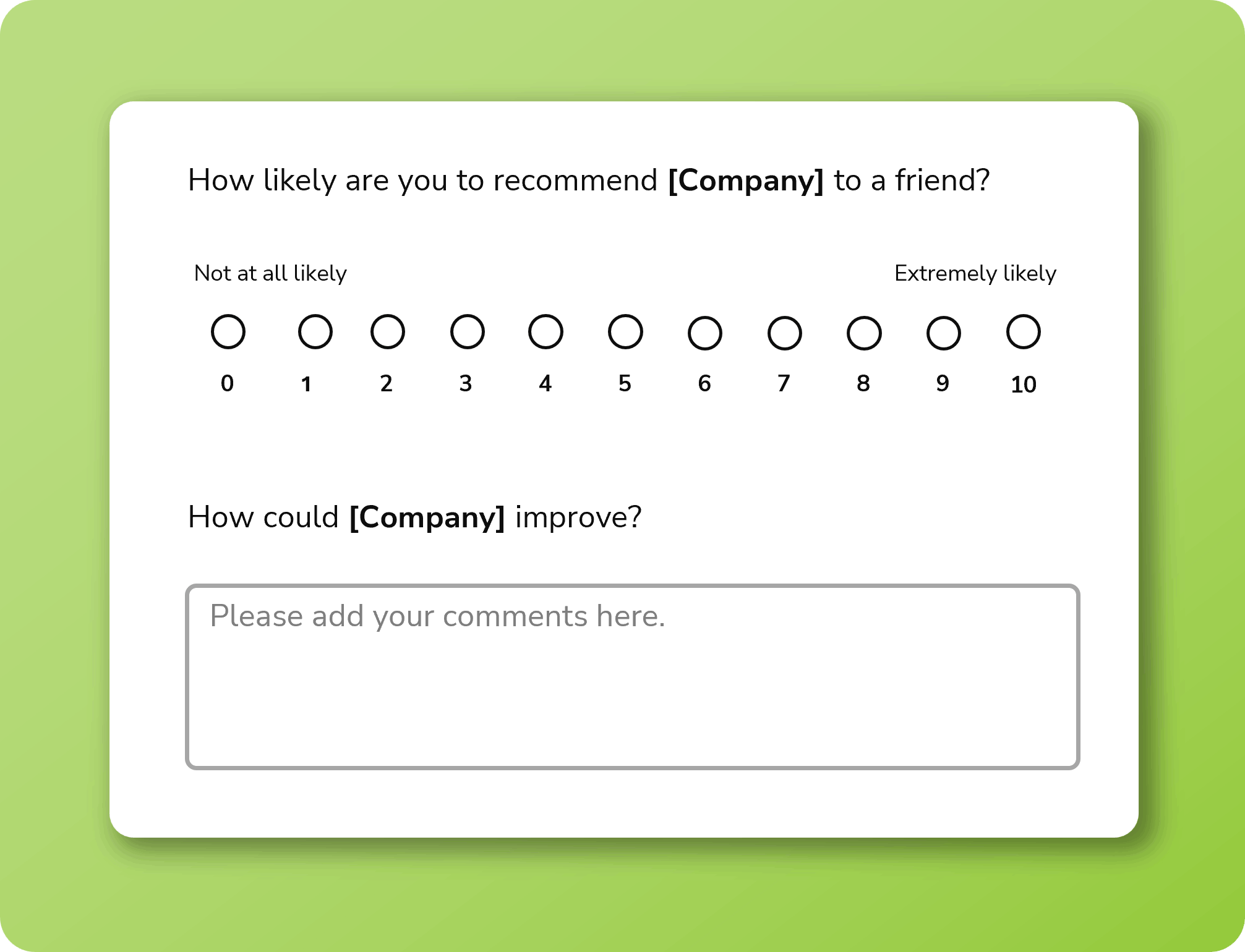
NPS is based on a simple but powerful idea: customer loyalty can be measured by asking one key question:
“How likely are you to recommend our company to a friend?”
That’s the NPS question. And your answer—your Net Promoter Score—helps you measure customer satisfaction, customer sentiment, and the health of your customer experience.
TrueData™ Surveys are for B2B Companies
with High-Value Customer Relationships


A good customer survey isn’t one click. It’s dozens of steps.
We handle them all.
Let’s streamline your survey and give you data you can trust.
Built-In Features that Drive Growth

Software included.
No add-on costs. No upsells. No separate licenses. Just results.

Custom design. Bias-free.
Built from scratch to match your goals—no templates, no leading questions, no fluff.

Thematic insights.
Evidence based, statistically valid data presented in priority order.

Human-coded text analysis + AI.
Every open-ended response coded for nuance and clarity.

Highest response rates!
100% deliverability. 100% engaging. Surveys customers want to take.

CEO-ready Findings Reports.
Action-focused presentations designed for executives and frontline teams.
Trusted by Companies Like Yours

The AI Survey Trap
AI builds surveys from templates, not experience. At Interaction Metrics, we use AI where it adds value and lose it where it doesn’t. Our analysts supply the oversight, alignment, and objectivity that AI can’t.
Built for B2B teams that need survey experts, not another DIY tool.
Only Need Software
Level 1
If you already have your survey designed, power it up with the best software and the experts who know how to use it.
$1500-$3000
Complete Design & Deploy
Level 2
All your survey questions, logic flow, rating scales, email campaign, and every other step are managed for you.
$6000-$9900
Get The Analysis Too
Level 3
Crosstabs, correlations, text analysis, dashboards, and findings decks with next-step actions presented to your team.
Varies by Complexity

Need Something More Tailored?
Not every challenge fits neatly into a package. We build custom research and survey strategies for teams with unique goals, complex audiences, or multi-phase initiatives.
What this Free NPS Calculator Does (and Why It’s Better)
This free NPS calculator gives you more than a numerical score. You’ll not only calculate your Net Promoter Score—you’ll see how it stacks up against real-time NPS benchmarks across industries. With just a few inputs, you’ll gain a snapshot of your brand’s current customer loyalty, helping you prioritize where to dig deeper.
Unlike generic survey software, our calculator is designed for clarity. There’s no fluff, and no attempt to gloss over unhappy customers with inflated averages. We want you to see what your score really means—and what to do next.
Here’s how it works:
- Enter how many survey respondents fell into each NPS category: Detractors (0–6), Passives (7–8), and Promoters (9–10)
- Select your industry
- Instantly get your NPS score, breakdown of percentages, and a benchmark comparison
Your result isn’t just a net promoter score calculation—it’s a reflection of customer perception. It shows whether your customer experience earns loyalty or needs attention.
And because we know the score is just the beginning, the rest of this page breaks down what your number actually means—and how to improve it.
What Is Net Promoter Score (NPS), Really?
Net Promoter Score (NPS) is one of the most widely adopted metrics in customer experience. It’s deceptively simple, built around one key question:
“How likely are you to recommend our company to a friend or colleague?”
Based on their answer, customers are categorized as:
- Promoters (score of 9–10): These are your advocates. They tend to buy more, stay longer, and refer others.
- Passives (score of 7–8): They’re neutral—satisfied, but not enthusiastic. They’re vulnerable to churn.
- Detractors (score of 0–6): They’re unhappy, and they can damage your brand through negative word-of-mouth.
The NPS formula is simple:
% of Promoters – % of Detractors = Your NPS Score
Passives are counted in the total number of survey responses to calculate the percentage breakdown, but they don’t affect the score directly. This distinction matters—especially if you have a lot of fence-sitters.
How to Calculate Your NPS (with an Example)
Let’s say you surveyed 200 customers.
- 100 gave you a 9 or 10 (Promoters)
- 50 gave you a 7 or 8 (Passives)
- 50 gave you a 0 through 6 (Detractors)
Here’s how to calculate NPS:
- Promoters = 100 ÷ 200 = 50%
- Detractors = 50 ÷ 200 = 25%
- NPS = 50% – 25% = NPS of 25
This NPS score suggests you’re doing well—you have more promoters than detractors. But to really know what that means, you need to put your result in context.
That’s where benchmarking comes in.
How to Interpret NPS Scores (and Know if Yours Is Good)
A good NPS score depends entirely on your industry. In competitive markets like SaaS or ecommerce, the average NPS might be 30. In highly regulated spaces like insurance or healthcare, 10 might be excellent.
That’s why our calculator includes industry-specific Net Promoter Score benchmarks. With one click, you can see whether your score is falling short or setting the pace.
As a general rule of thumb, an NPS above 0 means you have more promoters than detractors. A score of 30 or more signals strong customer satisfaction and loyalty, 50+ is considered excellent, and anything above 70 puts you in world-class territory.
But these numbers are only half the story. What really matters is what the score tells you about your customer relationships.
Interpreting Your Score: The Hidden Story Behind the Number
Getting your overall NPS score is easy. But knowing what to do with it? That’s the hard part.
Here’s what most businesses miss: Your NPS doesn’t tell you what’s broken. It only tells you something might be. To make it actionable, you need to combine the score with customer insights, qualitative analysis, and segmentation.
This is especially true if you run transactional NPS surveys—short surveys after a support call or purchase. These surveys capture customer sentiment in the moment, but without interpretation, they’re just a data point.
Think of the score as a signal. A promoter score of 70 is great—but why is it 70? What do your customers love? Where are your detractors getting stuck? What messaging is causing confusion?
This is where companies using our NPS tool gain an edge. They don’t stop at measurement—they dig into open-ended feedback, analyze segments, and extract actionable insights that actually move the business forward.
Why Net Promoter Score Is More than a Metric
NPS was never intended to be a vanity metric. In the original Harvard Business Review article, Reichheld emphasized its use as a growth indicator—not a replacement for real analysis.
The Net Promoter system was designed to track loyalty, growth, and brand sentiment in a single number. It quickly became a key metric in customer success dashboards and executive reports.
But it’s often misused.
Too many companies treat NPS like a performance badge—focusing on the numerical score and not the customer journey behind it. This creates blind spots, where feedback looks good on paper but fails to drive improvement.
That’s why we always say: Your Net Promoter Score is just the beginning.
To make it meaningful, you need to:
- Analyze feedback beyond the number
- Identify which parts of the experience cause negative experiences
- Map score trends to specific customer segments or touchpoints
- Look for actionable feedback that reveals unmet needs or misaligned expectations
Whether you’re a startup or a global brand, the goal is the same: Use your NPS data to surface what matters—and then act on it.
The Problem With Most Net Promoter Score Tools
There are hundreds of NPS calculators and tools out there—but most of them fall short.
They might give you the score, but they don’t explain it. They don’t benchmark it. And they don’t help you understand what’s going on beneath the surface.
Some of them even bias the result. For example, some survey platforms add emojis or leading phrasing (“We hope you loved us—rate us!”), which artificially skews the outcome. That’s not real measurement. That’s marketing.
Our Net Promoter Score tool is different. It’s clean, neutral, and statistically grounded. You get the score, the net promoter score formula, the percentage of promoters and detractors, and an honest comparison to others in your space.
More importantly, it helps you see the bigger picture. You can spot trends. You can identify unsatisfied customers. You can start to improve.
What to Do After You Calculate Your NPS
Once you’ve used our NPS calculator to measure your score, don’t stop there.
Here’s what smart companies do next:
- Review open-ended comments to understand why customers responded the way they did.
- Segment by channel, customer type, product, or region to find hotspots.
- Prioritize the most common or urgent themes—and fix them.
- Repeat the survey quarterly or bi-annually to track progress over time.
These aren’t just good practices—they’re essential if you want your NPS to translate into real customer retention and business growth.
And if you need help making sense of what you find, we’re here. Our team can analyze your responses, identify themes, and turn data into clarity.
Why This Matters for Your B2B Company
Every company says they care about customers. But not every company actually listens.
Using a Net Promoter Score calculator is one way to show you’re serious. It means you’re willing to ask hard questions. You’re open to feedback. And you’re not afraid to look at the truth—even when it’s uncomfortable.
When done right, NPS unlocks:
- Better customer experiences
- Stronger customer relationships
- More promoters and referrals
- And yes, more data to back up your decisions
Whether you’re measuring performance after a support call or tracking brand loyalty year over year, the message is the same: Listen strategically. Act intelligently. Grow sustainably.
Final Thought: A Score Is Just the Beginning
So many companies use NPS. So few use it well.
Don’t just measure NPS. Make it part of how you think. Make it part of how you lead. Use it to understand what customers feel, what they expect, and what your next move should be.
Want help with that? We’ve built entire systems around turning survey responses into actionable insights—no guesswork, no gimmicks.
Build a Better NPS Survey
Too many companies rely on generic surveys that skew results and miss what really matters.
If your NPS is based on biased questions or flawed logic, your score won’t reflect reality—and it definitely won’t help you improve.
That’s why we design custom NPS surveys that eliminate leading language, capture open-ended feedback, and reveal what’s driving customer sentiment.
Whether you need a transactional survey after support calls or a relationship survey to track brand loyalty, our team will build a scientifically sound NPS survey tailored to your customers and your business.
Use this NPS formula calculator today. Then let’s talk about what it means for your brand tomorrow.
Frequently Asked Questions
NPS is a standardized way to measure customer loyalty using survey responses. It’s based on one question: “How likely are you to recommend our company to a friend or colleague?” Customers respond on a 0–10 scale. You calculate NPS by subtracting the percentage of detractors (those who answered 0–6) from the percentage of promoters (those who answered 9–10).
Use this formula:
% of Promoters – % of Detractors = Net Promoter Score
Passives (scores of 7–8) are included in the total count to calculate the percentages but do not directly affect the score. This calculator automates that for you.
Our calculator automates that for you—so you can calculate your Net Promoter Score in seconds and move straight to interpretation.
A good NPS varies by industry, but in general:
- 0 or above means you have more promoters than detractors
- 30+ signals loyalty
- 50+ is excellent
- 70+ is world-class
Use our tool to find out how your score compares to others in your field—and see if you have a good Net Promoter Score for your industry.
Yes. Whether you’re collecting ongoing feedback (relationship NPS) or measuring a single moment (transactional NPS surveys), the formula remains the same. Just be sure your sample size is large enough to be reliable.
A low score usually comes from a cluster of passives or a small group of detractors, and the fix starts with understanding why. Don’t react to the number alone. Look at the open-ended feedback, segment results by customer type, region, or product line, and find the specific drivers. The score tells you there’s a problem; the analysis tells you what to do about it. This is the part a calculator can’t do, and where a full NPS program earns its keep.
NPS was introduced by Fred Reichheld, in partnership with Bain & Company and Satmetrix Systems. It’s now used by companies worldwide as a key metric for tracking loyalty and customer perception.
More Resources:

What is a Good Net Promoter Score (NPS)?
Net Promoter Score (NPS) is a specialized customer loyalty metric that measures the likelihood of a customer recommending a brand to a friend or colleague on a scale of 0 to 10. 66% of companies: This is the proportion of Fortune 1000 companies that rely on Net Promoter Score to benchmark their performance and improve […]

How to Improve Your NPS Score: 21 Strategies
Your Net Promoter Score (NPS) isn’t just another number—it’s a direct reflection of customer trust and customer loyalty. A high NPS means happy customers who are eager to spread the word about your business, fueling growth and strengthening your brand reputation. But here’s the problem: too many companies chase a better NPS the wrong way—bombarding […]

How To Choose Net Promoter Score Vendors, Consultants & Survey Companies
Last Updated: April 3, 2025 When you start shopping for a Net Promoter Score (NPS) partner, you’ll find no shortage of options. From survey platforms to consultants and tech vendors, it can feel like every company is suddenly a Net Promoter Score expert. But what most companies offer is the easy part: sending your NPS […]

The Cost of Customer Satisfaction: B2B Survey Program Costs
Last Updated: February 24, 2025 What are typical customer survey program costs? Clients ask this all the time, and the answer varies widely. A simple, off-the-shelf survey might cost very little, while a B2B survey program with multiple customer types, account data, segmentation, and deeper analysis requires a bigger investment. If you’re considering options, surveys […]