TrueData™ SURVEYS
Survey Reliability: B2B Bias Buster Tool
Improve your survey fast. Scrub biases from your survey with our free tool.


B2B Survey Experts + Third-Party Objectivity + Software Included
We bring certified CX analysts (CCXP) and proven methods. You’ll have an engaging survey with data you can trust.
Use Our Survey Bias Buster
Just one biased question can derail your entire survey. The Survey Bias Buster flags vague wording, leading phrases, and skewed answer options—so you can fix them fast.
Paste in your question, and get clear explanations and tips to improve clarity, fairness, and data quality.
This tool flags common signs of survey bias, but context matters, so use it as a smart first pass—not a final verdict.
Talk to a Survey Expert
The world doesn’t need more customer surveys.
It needs better ones.
Relevant questions ➔ Reliable data ➔ Clear direction.
Curious or have a customer survey challenge? Share a few details. A CCXP-certified survey expert will follow up.


"*" indicates required fields
How Survey Bias Works
Survey bias isn’t always obvious. In fact, some of the worst examples hide behind friendly phrasing or good intentions. Bias can creep in through:
- Loaded or emotional words
- Presumed knowledge or feelings
- Complex or double-barreled question structure
- Leading questions that nudge people toward agreement
- Answer sets tilted toward positive responses
The position of answer options, especially on digital devices, can also influence how respondents interpret and select their answers, as the layout and visual hierarchy of the scale’s positions may affect their choices.
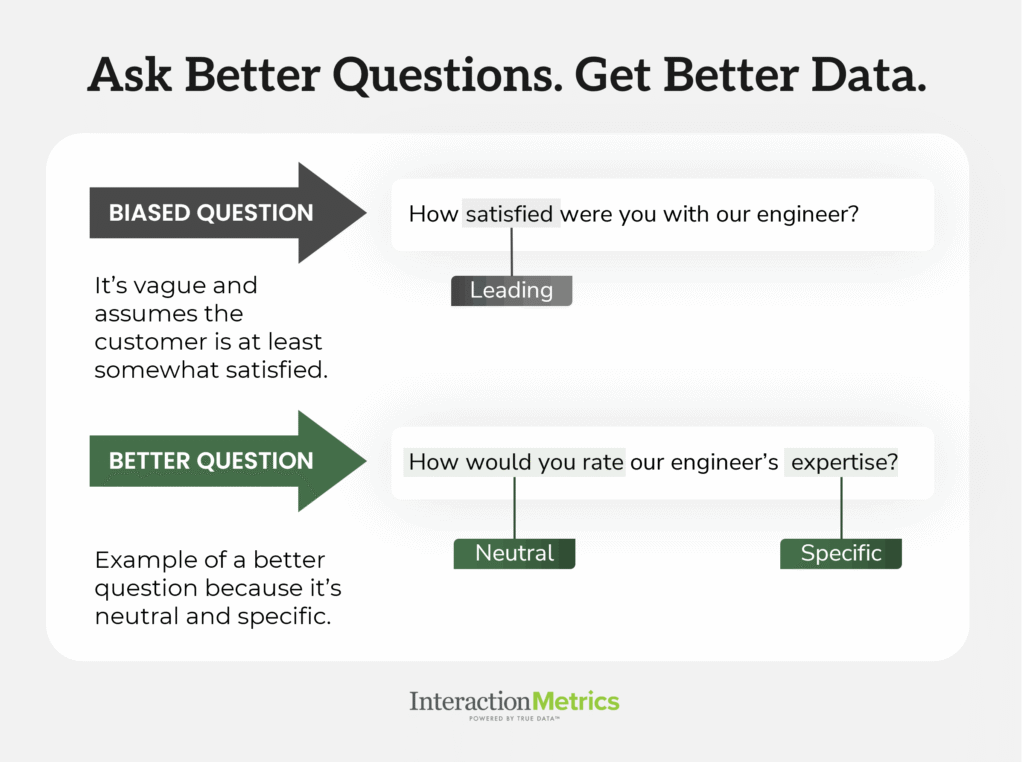
You might think you’re asking, “How satisfied were you with your service?” But what your respondent hears might be “Tell us you were satisfied”—a subtle cue steering them toward a certain answer. That subtle nudge distorts your survey results and erodes trust in the data.
TrueData™ Surveys are for B2B Companies
with High-Value Customer Relationships


A good customer survey isn’t one click. It’s dozens of steps.
We handle them all.
Let’s streamline your survey and give you data you can trust.
Built-In Features that Drive Growth

Software included.
No add-on costs. No upsells. No separate licenses. Just results.

Custom design. Bias-free.
Built from scratch to match your goals—no templates, no leading questions, no fluff.

Thematic insights.
Evidence-based, statistically valid data presented in priority order.

Human-coded text analysis + AI.
Every open-ended response coded for nuance and clarity.

Highest response rates!
100% deliverability. 100% engaging. Surveys customers want to take.

CEO-ready Findings Reports.
Action-focused presentations designed for executives and frontline teams.
Trusted by Companies Like Yours

We supply the oversight, trust, and alignment that AI can’t.
Use AI where it adds value, lose it where it doesn’t. Built for B2B teams that need survey experts, not another DIY tool.
Only Need Software
Level 1
If you already have your survey designed, power it up with the best software and the experts who know how to use it.
$1500-$3000
Complete Design & Deploy
Level 2
All your survey questions, logic flow, rating scales, email campaign, and every other step are managed for you.
$6000-$9900
Get The Analysis Too
Level 3
Crosstabs, correlations, text analysis, dashboards, and findings decks with next-step actions presented to your team.
Avg. $12000-$40000

Need Something More Tailored?
Not every challenge fits neatly into a package. We build custom research and survey strategies for teams with unique goals, complex audiences, or multi-phase initiatives.
Why We Built the Survey Bias Checker
We created this tool because we saw a persistent problem: companies launching surveys filled with leading questions, vague phrasing, and unbalanced rating scales—without realizing the damage. These issues were undermining survey validity and reliability, making it impossible to trust the results.
We’ve seen firsthand how flawed questions show up in real-world surveys—sometimes from major brands—and the consequences are costly. See examples of what to avoid.
Our tool is your first line of defense. Just paste in your survey question, and we’ll flag biased language, double-barreled constructions, poor scale design, and other red flags. It’s a fast, science-backed way to ensure every question contributes to the overall reliability and validity of your survey.
Successful customer experience survey strategies depend not only on good design, but also on careful implementation and ongoing support to achieve meaningful results.
What Happens When Survey Questions Are Biased?
When bias enters your survey, you stop collecting real feedback. Instead, you collect confirmation of assumptions. Here’s what suffers:
- Validity: You’re no longer measuring what you intended.
- Reliability: You can’t count on similar results over time.
- Stakeholder trust: The data looks manipulated, even when it wasn’t meant to be.
That’s why avoiding bias should be a top priority in any feedback initiative. Too often, biased survey questions disguise themselves as conversational or “friendly”—but they silently erode both survey reliability and credibility.
Anatomy of a Biased Question
Take this example:
“How helpful and proactive was your service rep?”
This question seems simple, but it does three problematic things:
- It’s double-barreled—asking about helpfulness and proactivity in one item.
- It presumes positivity.
- It lacks a neutral or negative answer option in many common scale formats.
This question won’t produce accurate data. Instead, it limits feedback and inflates scores. Our tool helps you spot these problems before they reach the field.
Answer Set Bias—The Hidden Problem
Even if your question phrasing is neutral, your answer options can introduce bias. Consider this:
“How satisfied were you with the service?” A. Extremely satisfied B. Very satisfied C. Satisfied D. Somewhat satisfied E. Neutral
What’s missing? Any way to express dissatisfaction. Effective answer sets should include multiple options that span the full range of sentiment—from strong approval to clear discontent.
The form of your answer options—whether balanced or unbalanced—directly impacts the validity of your survey responses. If the form is skewed, it can undermine the accuracy and appropriateness of your assessment.
This is an unbalanced rating scale. It pushes respondents toward a positive answer—even if that’s not how they feel. Our tool checks for this too, ensuring your answer sets give respondents equal opportunity to speak their truth.
Flawed answer structures not only limit feedback—they degrade the overall quality of your survey data.
Why You Should Never Use Only One Survey Question
One-question surveys might seem efficient—especially when you ask something like:
“How likely are you to recommend us?”
But one question is never enough. It lacks depth. It’s susceptible to leading questions, and it doesn’t provide diagnostic value. If scores are low, you won’t know why. If they’re high, you may be misled by biased wording or skewed answer sets.
To meet standards for survey validity and reliability, you need multiple well-crafted items that work together to uncover what matters. A single-question format doesn’t allow for segmentation, survey reliability checks, or triangulation of emotional nuance.
In short: fewer questions might be convenient—but they often sacrifice validity and long-term impact.
What Is a Valid Survey?
A valid survey measures exactly what you intend it to measure—nothing more, nothing less. For example, if you’re aiming to assess customer trust, don’t ask about brand appeal or speed of service. Validity means each question has a purpose and supports your research goals.
Key components of validity:
- A clear objective behind each question
- Neutral, precise language
- Scales aligned with the topic
- Testing with a diverse sample size
- Giving respondents multiple options to express their experiences accurately.
Validity isn’t about being “nice”—it’s about being accurate. It helps you determine whether your questions are aligned with what you’re actually trying to learn.
What Is Survey Reliability?
Survey reliability means your survey performs consistently. If you repeated it with the same people or with a similar population, the results should align.
Reliability fails when:
- Questions are ambiguous or poorly worded
- Scales are confusing or skewed
- Context shifts between respondents
- Responses can vary depending on the day or current mood, so specifying a time frame like ‘today’ in questions can improve reliability.
Our tool checks for these reliability risks by analyzing question structure, phrasing, and scale clarity.
The Risk of Recycled Survey Questions
Many companies reuse old survey questions year after year. While this saves time, it can create issues with survey consistency, validity, and reliability. Language evolves. Customer expectations change. A once-reliable item can become outdated—or even biased.
Use our tool to re-test old questions. Regular review is essential not just for clarity, but to maintain survey reliability across evolving customer expectations. Having the right skills to design and review surveys is crucial to avoid bias and ensure reliable results. Especially if you’re conducting longitudinal surveys, consistency only matters if the original question is still doing its job.
Biased Survey Questions in Employee Feedback
Employee surveys are particularly prone to bias—because of power dynamics and workplace pressure. For example:
“How much do you appreciate your manager’s leadership style?”
This question assumes appreciation and lacks neutrality. It’s likely to inflate scores and silence dissent.
To get honest responses, your employee questions must be anonymous, clearly worded, and emotionally neutral. Use our tool to test for bias and protect your data—and your people.
Biased Survey Questions in Product Feedback
Product surveys often include questions like:
“How much do you love our new feature?”
That’s not research—it’s a pitch. It’s a leading question that encourages affirmation.
Even “better” product questions can fail due to scale bias. If you offer three versions of “yes” but only one way to say “no,” your survey results will be skewed. The Survey Bias Checker ensures you’re hearing the full truth. Without careful phrasing, your product survey may encourage a certain answer that doesn’t reflect true user sentiment.
Leading questions in product research also make it difficult to gauge real friction or unmet needs—two areas where feedback is most valuable.
The Role of Words in Survey Design
Words matter. A lot.
- A single adjective can imply a positive or negative evaluation
- An unclear verb can lead to ambiguous responses
- A missing noun can make the question too vague
Good survey writing is both technical and empathetic—it’s how you get clear, trustworthy survey responses. The Pew Research Center’s guidelines on questionnaire design echo this point, emphasizing the importance of wording that’s neutral, clear, and easy for all audiences to interpret.
You must consider how your respondents will interpret each word, each scale, and each topic. Our tool helps—but for high-stakes surveys, a human review adds even more depth.
Poor word choice is one of the most common causes of biased survey questions—and the easiest to fix when you know what to look for.
When to Call in a Third Party
Some teams can spot bias internally—but most can’t. Internal stakeholders are often too close to the product or the outcome to write truly neutral surveys.
Bringing in a third party helps because we:
- Have no emotional investment in the outcome
- Understand the science of statistical validity
- Can see jargon and bias in phrasing that insiders overlook
- Ensure that your survey design stands up to scrutiny
That’s what our TrueData™ methodology delivers: survey questions that reflect your goals without distorting the data.
A Real-World Example: How a “Beautiful Store” Question Backfired
A national retailer once asked customers:
“How enjoyable was your most recent visit to one of our beautiful stores?”
The question seemed harmless. The results were glowing. But sales were down. When we reviewed the survey, we spotted the issue: the word “beautiful” created social pressure to agree. Dissatisfied customers didn’t want to sound negative—so they checked “Very enjoyable.”
Once we rewrote the question in neutral terms and rebalanced the rating scale, the truth emerged. Customers were frustrated with wait times and under-staffing. The revised data helped the company make real improvements.
How This Tool Supports Better Customer Experience
If you’re committed to improving customer experience, this tool gives you a head start. Biased surveys produce inaccurate results—and inaccurate results lead to misguided strategy.
We built this tool to help you:
- Ask clearer questions
- Avoid assumptions
- Spot flawed scales
- Build a foundation of valid, reliable, and actionable survey insights
It’s a fast, easy way to begin avoiding biased questions that could undermine your entire customer experience program.
For full-scale feedback programs—from brand surveys to Net Promoter and customer service evaluations—we handle the design, delivery, and analysis for you.
From product feedback to NPS alternatives, this tool supports better decisions at every level. It helps ensure your survey responses reflect what customers actually think—not what the question suggested.
Ready to Improve Your Survey Results?
You’ve seen how bias distorts feedback. You’ve learned how survey validity and reliability are essential for good data. Now it’s time to put that knowledge to work.
- Paste your question into the Survey Bias Checker
- Get immediate, expert-backed feedback
- Fix what’s broken—before it costs you customers or credibility
Need a full review of your entire survey? Let’s talk.
We’re here to help you evaluate every question for reliability and validity—so your data holds up to scrutiny.
Frequently Asked Questions
Three categories cause most problems.
- Sampling Errors:
These occur when your sample doesn’t represent the full target population. For instance, if you only survey your most active customers, your survey responses won’t reflect the broader customer experience. This type of error makes it difficult to determine whether your results apply beyond that specific group. - Non-Response Errors:
When people skip questions or choose not to participate, your data set becomes incomplete. If only those with extreme opinions respond, your survey data will be skewed—and less useful for making balanced decisions. - Measurement Errors:
These arise from poorly written survey questions. Vague questions, confusing phrasing, or unbalanced answer sets introduce bias and reduce survey reliability. Even one poorly constructed item can compromise your entire survey.
Survey validity means your question measures what it’s supposed to measure. If you’re assessing customer satisfaction, the question should directly focus on satisfaction—not on speed, pricing, or unrelated attributes.
Survey reliability refers to consistency. If someone answers today and again next week—or a similar person takes the same survey—the results should align. That’s what makes a survey reliable.
A truly effective survey must have both validity and reliability. You need to measure the right things, and you need results you can trust.
Bonus: Internal validity ensures your results come from the factor you’re testing—not a confounding variable. Without this, your conclusions may be way off.
Bias skews your survey results by influencing how people respond. It undermines validity and reliability, leading to data that may look positive on the surface—but fails to reflect reality.
Bias can enter through:
- Emotionally loaded language
- Assumptions built into the question
- Leading or vague phrasing
- Imbalanced answer sets
Even just one question can distort your entire survey, costing you valuable insight and leading to poor business decisions.
When designing surveys, it’s important to focus on identifying the following types of problematic questions, such as double negatives, jargon, double-barreled questions, leading questions, loaded questions, mismatched scales, and unclear answer options. Identifying these issues ensures your survey is clear and unbiased.
Here are a few common examples—and why they fail:
- “How great was your experience with our award-winning team?”
A leading question. It assumes the experience was great. - “How helpful and efficient was the representative?”
A double-barreled question. What if the rep was helpful but not efficient? - “What do you love most about our product?”
A loaded question. It assumes the respondent loves the product. - “How was it?”
Too vague. It offers no context for what’s being measured.
Our Survey Bias Checker detects patterns like these and helps you fix them before they compromise your data.
A double-barreled question combines two questions into one, but only allows for a single answer. For instance:
“How satisfied are you with your rep’s knowledge and timeliness?”
If the rep was knowledgeable but not timely, how should the respondent answer? These questions confuse people and distort feedback.
Our tool flags double-barreled constructions so you can break them into clear, separate items.
Yes. Open-ended doesn’t mean neutral. “What do you love about our service?” frames the response positively even though there’s no rating scale. The neutral version, “What stands out to you about our service?”, invites the full range of honest input. If your survey includes open-ended questions, they need the same bias review as the rest.
Yes. This tool works for any type of survey: employee engagement, customer satisfaction, market research—you name it. Bias can show up anywhere, whether you’re surveying staff, customers, or partners.
The tool helps you identify and remove the structural issues that undermine honest responses. If you’re collecting feedback from the general population or niche B2B buyers, this tool supports better, more reliable survey results.
More Resources:

Survey Bias: The 20 Biggest Losers
This morning, my rep texted me from the shop where my car is serviced: “You’ll receive a survey from us. It would mean a lot to me if you completed it. We hope you recommend us.” I get he wants a positive review, but this is an example of clear survey bias. Essentially, my rep […]

Rules for Writing B2B Customer Satisfaction Survey Questions
Last Updated: February 10, 2026 Effective B2B customer satisfaction surveys are designed to produce decisions, not just data. To move beyond generic ratings, B2B firms must use role-based routing, suppression strategies, and expectation-gap mapping. This guide outlines the essential rules for transforming B2B surveys into strategic assets that protect revenue and improve customer retention. The […]

Top Customer Satisfaction Survey Companies of 2026
Last Updated: April 2, 2026 Key Takeaways: A great customer satisfaction survey company does more than send a form and count answers. It helps a business ask better questions, hear the right customers, and understand what the feedback means. The right partner helps you measure customer satisfaction in a way that is credible, useful, and […]

From a Data Die-Hard: How to Write Good Survey Questions
Does your company issue customer surveys, but you’re not getting the insights you need? Read on for a quick class on how to write good survey questions that result in objective, actionable data. Are you looking to improve your data right away and don’t want to read this entire post? Here are three tips I […]