
Are you an HR Director, Head of People, HRBP, Chief People Officer, or a business leader responsible for retention and performance? If so, this article is for you, because, presumably, your goal isn’t merely to collect employee feedback and measure employee engagement, it’s to get honest insight you can use.
First, let’s start with a key difference: how an employee questionnaire differs from a customer survey.
The questionnaire is the set of questions you are asking; the survey is the entire strategy, of which the questionnaire is just one part. Your survey considers who receives it, when it is sent, and how anonymity is protected.
At Interaction Metrics, we design and deploy employee questionnaires as part of end-to-end survey programs. With us, you’ll have analyses that ensure your data incites action. Employee engagement surveys, workplace culture surveys, and employee net promoter score (eNPS) are just a few of the types of employee surveys we offer. Ask a question.
In addition, your survey includes how you will encourage participation, how you will segment results by role, how you will interpret the open-ended comments, and how you will translate the ratings and text into decisions about employee retention and workplace culture.
How are employee questionnaires different from customer questionnaires? Basically, in an employee survey, your staff weighs risk as they answer. They may wonder whether their immediate manager will see the data, whether senior leadership will take the feedback seriously, and whether honest communication could lead to negative consequences.
That’s why employee survey questions have to be written with extra care. To get candid feedback, you need a questionnaire that feels safe while asking neutral and specific questions.
The opportunity here is significant. Gallup reports that only 21% of workers are actively engaged; the majority of staff are either not engaged or worse yet, they are actively disengaged. When employees are not invested in their work, organizations feel the punch in lower productivity, weaker performance, and higher staff turnover. Bottom line, ignoring workplace concerns does not just hurt morale—it quietly erodes business results.
Takeaways: Employee Feedback-What You Need to Know
System vs Tool: A questionnaire is just the questions; a survey is the entire program of sampling, timing, analysis, and follow-through.
Employee Surveys Require Trust: Fear of retaliation affects how employees respond. Therefore, offering the option for anonymity and putting in place communication best practices is key.
Precision Beats “Nice Scores”: Generic questions create generic data; targeted questions yield valuable data you can use.
Scores That Drive Decisions: While you will want to incorporate outcome scores like employee satisfaction or eNPS, reporting on the specifics along with the emergent text themes is where the action lies.
How Is A Survey Different From A Questionnaire?
Surveys differ from questionnaires because a questionnaire is simply the instrument—the list of questions you ask—whereas a survey is the strategic architecture designed to protect and interpret those questions. Think of the questionnaire as the “what” and the survey as the “how.”
In an employee context, the survey methodology is as important as the questions themselves. It encompasses your protocol for ensuring anonymity, the timing of the delivery so it doesn’t clash with peak workloads, the segmentation of data across departments, and the scientific weighting used to turn raw ratings into a leadership roadmap. If you have a great questionnaire but a flawed survey process, employees will sense the risk and withhold the truth.
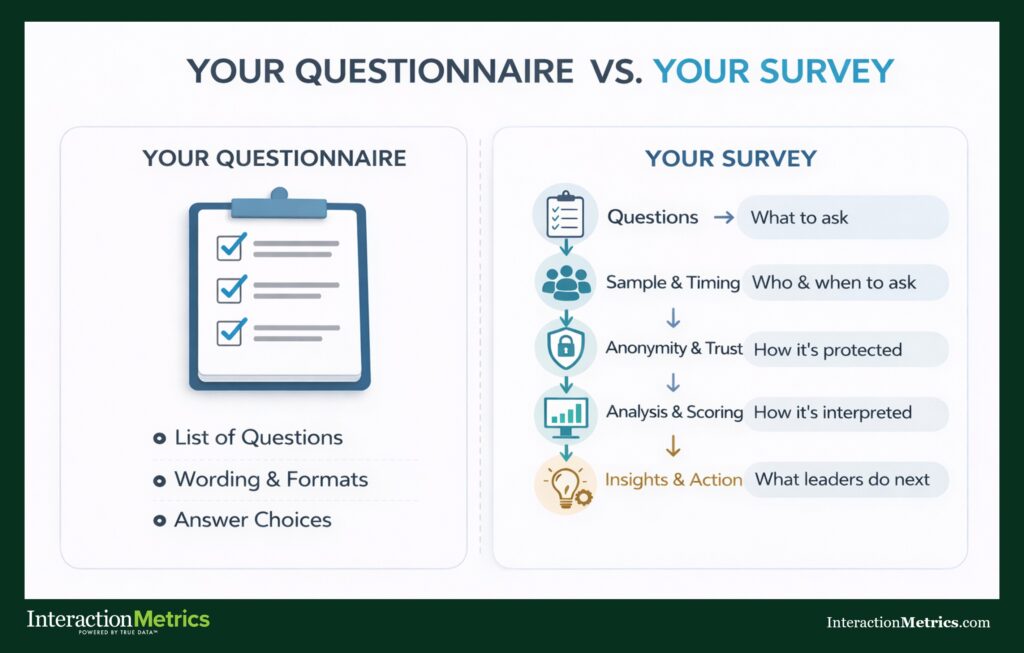
Employee Survey Your Entire Feedback System
How Are Employee Questions Different From Customer Questions?
Employee questions differ because power dynamics easily suppress honest communication, so the wording needs to be handled much more carefully than in a customer survey. Employees calibrate what they say based on whether they believe the survey is truly anonymous and safe, and whether they assume this is genuine listening or more of an HR vanity project.
That’s why an employee questionnaire has to do two jobs at once: gather employee feedback and reduce the conditions that make staff self-censor.
Why Do Employee Questionnaires Fail Even When Employee Engagement Looks “Fine”?
Employee questionnaires fail when questions are generic, emotionally loaded, or too broad to diagnose what employees feel day to day—so the results look positive while underlying problems persist. Many teams get a “fine” engagement survey result and still see rising attrition, inconsistent employee performance, and persistent frustration in the work environment.
When the questions don’t isolate drivers like current work-life balance or manager effectiveness, the findings fail to be ‘decision-grade’. However, when designed with precision, the Harvard Business Review finds that surveys remain one of the best ways to predict employee behavior, such as turnover, because they allow leaders to understand the why behind the numbers before it’s too late.
How Do You Choose the Right Type of Employee Questionnaire?
You choose the right employee questionnaire by matching your questionnaire to the aspects of the employee experience you need to improve.
Use employee engagement questionnaires to understand commitment, motivation, and connection to your company’s goals.
Use employee satisfaction questionnaires to identify practical problems with workload, tools, fairness, or job conditions
Employee onboarding questionnaires are invaluable for improving ramp time and catching problems early.
Exit questionnaires show you why employees leave and what could have changed the outcome.
Workplace culture questionnaires gauge team dynamics and often ask the most ‘out of the box’ creative questions.
| Questionnaire Type | What It Measures | Best Used For… |
|---|---|---|
| Employee Engagement Questionnaire | Commitment, motivation, connection to company goals | Improving employee engagement and tracking key metrics over time |
| Employee Satisfaction Questionnaire | Job satisfaction and conditions of work | Finding practical fixes in policies, tools, workload, and fairness |
| Employee Onboarding Questionnaire | Early clarity, enablement, support, and readiness | Improving ramp time and preventing early turnover |
| Exit Questionnaire | Reasons people leave and what might have changed the outcome | Reducing regrettable attrition and redesigning problem systems |
| Workplace Questionnaire (Umbrella) | Workplace culture, organization’s culture, and team dynamics | Diagnosing culture patterns across departments and levels |
What Question Formats Produce Valid Responses in Employee Surveys?
Employee survey questions yield accurate responses when you combine rating questions with focused follow-ups that let employees explain in a few words what’s driving their rating. This approach captures both quantitative data (what’s changing, where) and qualitative data (why it’s changing).
For example, you might ask a rating question about whether employees feel supported by their immediate manager, then follow with an open prompt that asks for “a few words” on what would help. This is how you move from “scores” to meaningful feedback.
What Creates Bias and Noise in Employee Survey Questions?
Bias and noise come from leading wording, double-barreled questions, vague prompts, and demographic questions that make employees perceive they could be identified. When employees perceive risk, they often provide safer answers—or skip items entirely—so your survey results can look smoother than reality.
A practical example: “How satisfied are you with leadership?” can mean senior leadership, a direct supervisor, or a single recent decision. That ambiguity produces noise. A clearer question isolates the target: “Senior leadership communicates decisions promptly,” or “My immediate manager gives me clear priorities for the week.”
What Are Some Good Versus Bad Employee Questionnaire Question Examples?
Good employee questionnaire examples are specific, neutral, and tied to a decision, while weak questions are vague, emotionally loaded, or combine too many ideas at once.
If your question is leading, you risk pushing employees toward a more positive answer than they really mean. If your question is double-barreled, you cannot tell which part of the statement drove the response. If your wording is vague, the data may sound useful, but give you nothing clear to act on.
If your answer choices force employees into the wrong box, the results become noisy. And if your demographic questions are too specific, employees may worry they can be identified, which makes candid feedback hard to get.
| Problem Type | The “Bad” Question | The “Better” Question | Why It Works |
|---|---|---|---|
| Leading | “How satisfied are you with our supportive culture?” | “How would you rate our workplace culture today?” | Removes the assumption and uses neutral wording |
| Double-Barrelled | “My manager cares and helps me grow.” | “My manager cares about my success.” | Isolates one attribute so the data is clear |
| Vague | “How is your experience here?” | “I have the necessary tools to do my job well.” | Targets a fixable driver in day-to-day work |
| Forced Choice | No “N/A” option for remote work questions | Include “Not Applicable (I Do Not Work Remotely)” | Prevents noise from guessing |
| Retaliation Risk | Overly specific demographic questions | Use fewer, broader demographic questions | Reduces identification concerns and increases candid feedback |
What is an Employee Engagement Questionnaire and What Should it Measure?
An employee engagement questionnaire measures whether employees feel motivated, connected to company goals, and willing to invest discretionary effort in their work. The point isn’t to produce a flattering engagement score—it’s to measure employee engagement in a way that predicts retention and performance.
Many engagement questionnaires fail because they ask “culture” questions that are too abstract. Decision-grade engagement survey questions stay concrete: “My work contributes to the organization’s goals,” “I feel motivated to do my best work,” and “My day to day work feels meaningful.” Then you pair that with one open follow-up that invites honest communication about what would improve the experience.
This is also where analysis matters: Total CX Score and CX Score help summarize the full program, while QCI helps weight what matters most to different employee groups (for example, frontline teams vs. corporate teams often prioritize different issues).
What is an Employee Net Promoter Score Questionnaire and What Does eNPS Really Tell You?
An employee net promoter score (eNPS) questionnaire measures whether employees would recommend your company as a place to work, but it becomes actionable only when it includes follow-ups and is compared to industry benchmarks. eNPS is a useful signal for leadership teams, but it should not be treated as “the truth” without context.
A weak eNPS design stops at the score. A stronger eNPS approach adds one or two structured follow-up questions that clarify what employees perceive as the reason for their rating—work life balance, career development, manager effectiveness, compensation fairness, or the work environment. Then your analysts translate the qualitative data into themes that link to decisions.
What is an Employee Satisfaction Questionnaire, and How Is it Different From Engagement?
An employee satisfaction questionnaire measures job satisfaction with conditions like tools, workload, fairness, and policies, which makes it ideal for diagnosing fixable friction. Engagement is about connection and motivation; satisfaction is often about whether work is workable.

If employees don’t have the necessary tools, if the work schedule is unpredictable, or if remote work policies feel inconsistent, satisfaction drops, and performance follows. Many companies treat satisfaction as “soft,” but dissatisfaction creates negative consequences: lower trust, lower effort, and higher turnover risk.
Good question examples include: “My workload is reasonable,” “My current work-life balance is sustainable,” “I have the necessary tools I need to do my job,” and “I feel treated fairly.” These are clearer than “Are you happy here?” and they produce measurable data you can use.
What is an Employee Onboarding Questionnaire and What Should it Focus on?
An employee onboarding questionnaire measures whether new hires have clarity, support, and enablement in the first weeks and months, which makes it one of the fastest ways to improve retention. Onboarding is where many organizations lose employees quietly: confusion, lack of tools, unclear expectations, and poor manager connection.
Decision-grade onboarding questions focus on reality: “I understand what success looks like in my role,” “I received the necessary tools to do my job,” “My immediate manager provides the support I need,” and “I know where to go for help.” Add one open-ended prompt for candid feedback, and you’ll learn what’s slowing people down.
What is an Exit Questionnaire and Why Do Many Companies Get it Wrong?
An exit questionnaire captures why employees leave and what might have changed the outcome, but many companies get it wrong by asking leading questions or treating it like a compliance step. Exit questionnaires often produce bland answers because employees don’t trust confidentiality, or they don’t believe the organization will act.
A better exit questionnaire is short, neutral, and decision-focused. It asks what the primary reason for leaving is, what could have realistically changed, and what themes leaders should address. It also avoids making people defend their choice. When you redesign exit questions properly, the feedback leads to practical changes in manager effectiveness, growth systems, role design, and culture—rather than vague “people leave for money” conclusions.
What is a Workplace Questionnaire, and When Should You Use it as an Umbrella?
A workplace questionnaire is an umbrella approach used to understand workplace culture, employee perceptions, and team dynamics across the organization’s culture. This is useful when business leaders need a broad read across departments, locations, or job families—especially when the work environment differs dramatically across teams.

Workplace questionnaires can cover topics like co-workers, collaboration, inclusion, workload norms, remote work experience, and how employees perceive senior leadership. The key is to keep questions focused so the results lead to action, not debates.
How Should You Handle Anonymity and Demographic Questions in Employee Surveys?
Anonymity should be designed, explained, and protected in employee surveys because fear of retaliation can reduce honest feedback and create less accurate responses. Employees don’t just evaluate the words on the page—they evaluate the system behind the survey process.
That means using clear anonymity thresholds, limiting overly specific demographic questions that could identify people, and communicating how results will be reported. When people respond with confidence, you get more accurate responses and more useful employee sentiment.
How Do You Turn Survey Results into Decisions Instead of “Nice Scores”?
You turn survey results into decisions by connecting quantitative patterns to qualitative meaning, then prioritizing actions using clear scoring and weighting. That’s where analysis becomes the differentiator.
At Interaction Metrics, we don’t stop at a single score. We use a variety of scores, benchmarking, and questions that weigh what matters most to different employee segments.
| Raw Employee Feedback | Qualitative Theme | Employee Ease Score | Actionable Priority |
| “I love my team, but the budget approval process takes weeks.” | Operational drags are annoying | 3.2 (Low Ease) | Streamline expense approval workflows. |
| “I’m doing the work of two people since the vacancy opened.” | Burnout risk | 2.1 (Critical) | Review headcount or redistribute project loads. |
| “The mission is great, but endless meetings really get in the way | Inefficient use of time is a burden | 4.0 (Moderate) | Launch formal meetings review for all high-potentials. |
We also use eNPS with industry benchmarks to contextualize advocacy, and Customer Effort Scores to quantify friction—how hard it is to get help, resolve issues, or navigate internal systems.
The result is not just data—it’s a prioritized roadmap.
The Right Questions Turn Employee Feedback Into Action
Well-designed employee questionnaires do far more than collect opinions. They expose what is strengthening your workforce, what is creating friction, and what is quietly putting retention, performance, and culture at risk.

When a survey relies on generic templates or broad, feel-good questions, the result is often surface-level data that looks comforting but offers very little direction. If you want to improve manager effectiveness, support employee growth, and build a healthier workplace culture, the questions have to be sharp enough to reveal the real drivers behind the employee experience.
That is where Interaction Metrics makes the difference. We design surveys that turn feedback into priorities, helping leaders see what matters, what’s getting in the way, and where action will have the greatest return. Let’s transform employee sentiment into a clear, credible roadmap your leadership team can use.
If you are ready to ask better questions, we are ready to help you design a questionnaire that produces better decisions. Whether your goal is to strengthen employee engagement, improve onboarding, reduce preventable turnover, or get more candid insight from exit feedback, we can help you choose the right questionnaire type and shape the right questions so the results lead to meaningful action.
Let’s build an employee survey program that gives you clarity.